

Board Performance · 2025
In this section15 topics
- Compliance Monitoring — Overview1 item
- Prevention of Conflicts of Interest3 items
- Prevention of the Use of Inside Information3 items
- Anti-Corruption4 items
- Whistleblowing6 items
- Selection of Directors & Chief Executives7 items
- Selection of Independent Directors2 items
- Director Development3 items
- Evaluation of Board & Subcommittee Performance3 items
- Subcommittees1 item
- Meeting Attendance & Remuneration6 items
- Supervision of Subsidiaries & Associated Companies4 items
- Board Duty Performance — Overview1 item
- Audit Committee Duty Performance2 items
- Executive Committee Duty Performance1 item
Compliance Monitoring — Overview
Monitoring of Compliance with Other CG Policies & Guidelines
Guidelines for Monitoring and Evaluating Compliance with Anti-corruption Measures
The Board of Directors and the Audit Committee are responsible for supervising the internal control system and giving opinions on the adequacy of the internal control system. The topics were evaluated based on "Internal Control System Sufficiency Evaluation Form" announced by the Office of the Securities and Exchange Commission and the Stock Exchange of Thailand. It evaluates in accordance with the framework of the COSO ERM 2017 (The Committee of Sponsoring Organizations of the Treadway Commission - Enterprise Risk Management - Integrating with Strategy and Performance) in five categories, which are
Control Environment
Risk Assessment
Control Activities
Information & Communication
Monitoring Activities
In 2025, Regarding the results of the internal control system review, there were no significant disadvantages or deficiencies found in the internal control system. Each process is approved and reviewed sufficiently.
Monitoring
The Board of Directors is responsible for reviewing the appropriateness of the anti-corruption policy annually by taking into account the effectiveness of the policy, and the compliance with the good governance principles of the business, including the Board of Directors’ suggestions on the development and improvement of previous policies. Each year the Internal Audit Department is responsible for reporting the results of the compliance with anti-corruption measures to the Audit Committee. The Audit Committee then gives opinions and suggestions for process improvement to the Board of Directors for consideration.
In 2025, the Company and its subsidiaries have no legal dispute or any violation of laws relating to corruption which are being investigated, prosecuted, or judged. In 2024, the Company received 1 case of whistleblowing through any channels which was the action against the Company's articles of association actions against the Company's regulations, code of conduct, policy on corporate governance, and anti-corruption policy and measures. The Company has implemented and established corrective measures for recurrence prevention.
Compliance with Good Corporate Governance Principles in Other Matters
The Board of Directors of Supalai Public Company Limited is well aware of the importance of corporate governance and social responsibility, as it is confident that good governance will contribute to the following:
Strengthening a good management system with transparency and accountability, which can enhance the Company’s potential to compete in the short and long terms for sustainable business growth and eliminate conflicts of interest that may arise.
Creating confidence among investors, both in the country and abroad, as well as financial institutions, business partners, all stakeholders through clear and transparent communication on an equal basis and adding value to shareholders in the long run by significantly taking into consideration all kinds of stakeholders.
Being a tool to measure the operations of the Company and examine all operations to improve their efficiency.
The Company has considered the "Corporate Governance Code for Listed Companies 2017" (CG Code), which was prepared by the Securities and Exchange Commission (SEC). Securities and Exchange Commission (SEC) a.) To implement good corporate governance principles in creating sustainable value for the business, there has been a follow up on the adherence to good corporate governance principles in other areas. The follow-up results indicate that the company has fully complied with the guidelines for each issue as follows:
Control to ensure that there are complete and correct operations on data storage and accounting recording as well as regulations established in regard to the connected transaction, the acquisition or disposition of assets, or major transactions of the subsidiaries, and also ensure that the preparation of financial statements is based on the same accounting policies used by the Company in order that the financial statements of the subsidiaries can be included in the consolidated financial statements properly and in a timely manner. Arrange for the reports on the operations and the financial statement of the Subsidiaries Company to be proposed to the Board of Directors for acknowledgment on a monthly basis.
The Company places great importance on fair and equitable human resource management by establishing policies and practices for employee welfare and care without discrimination based on gender, age, race, religion, disability, or any other status. The company aims to promote a work environment that respects human dignity and provides equal benefits and development opportunities to all employees. Welfare and benefits are regularly reviewed to ensure compliance with labor laws, international standards, and the appropriateness to economic and social conditions. Additionally, channels for receiving complaints and mechanisms for protecting whistleblowers are provided to foster trust and fairness within the organization.
The Company conducts its business with transparency, fairness, and adherence to the principles of fair competition. It has established a policy prohibiting directors, executives, and employees from engaging in any actions that may constitute monopolistic practices, price-fixing, the exchange of sensitive commercial information, or any other activities that limit or distort competition. The company continuously promotes understanding of business ethics and has implemented monitoring measures and disciplinary actions in case of violations to prevent legal and reputational risks to the organization.
The Company recognizes its responsibility toward the environment and the safety of all stakeholders by establishing systematic policies and measures for environmental, health, and safety management. These measures cover the prevention and reduction of environmental impacts and efficient resource use, and in terms of safety and occupational health, the company conducts regular risk assessments, training, and emergency drills to prevent work-related accidents and diseases, while also setting safety goals and indicators to continuously monitor and improve operational efficiency.
The Board of Directors supervises cybersecurity awareness with plans and installation of devices to prevent threats through cyber channels and secure information and information systems.
The Audit Committee assigns the Internal Audit Section to review the performance of subsidiaries by using the risk-based approach depending on each case to ensure that the subsidiaries have appropriate and sufficient internal control systems. The Internal Audit Section shall then report to the Audit Committee to further propose their opinions to the Board of Directors.
Each subcommittee reviews related policies and requirements of each committee and provides suggestions that are beneficial to the Company in accordance with the CG Code annually and presents them to the Board of Directors for approval accordingly.
Prevention of Conflicts of Interest
Has the Company Acted to Prevent Conflicts of Interest?
Yes
Operations in the Past Year
Prevention of Conflicts of Interest
The Company adheres to a conflict-of-interest policy, which all directors, executives, and employees, including those in subsidiaries and affiliates, must strictly comply with. All employees are required to report any conflict-of-interest situations upon commencement of employment, during annual reporting periods, and whenever there is a change in circumstances that may lead to a conflict of interest.
In cases where an employee suspects a potential conflict of interest, or if there is something that could lead others to perceive a conflict of interest, they must immediately report it to their supervisor and submit a report to the corporate governance unit. This reporting process is a key internal control mechanism for the Company. The audit committee has assigned the internal audit unit to oversee, monitor, and report on these situations, submitting findings to the audit committee and the board of directors by February of each.
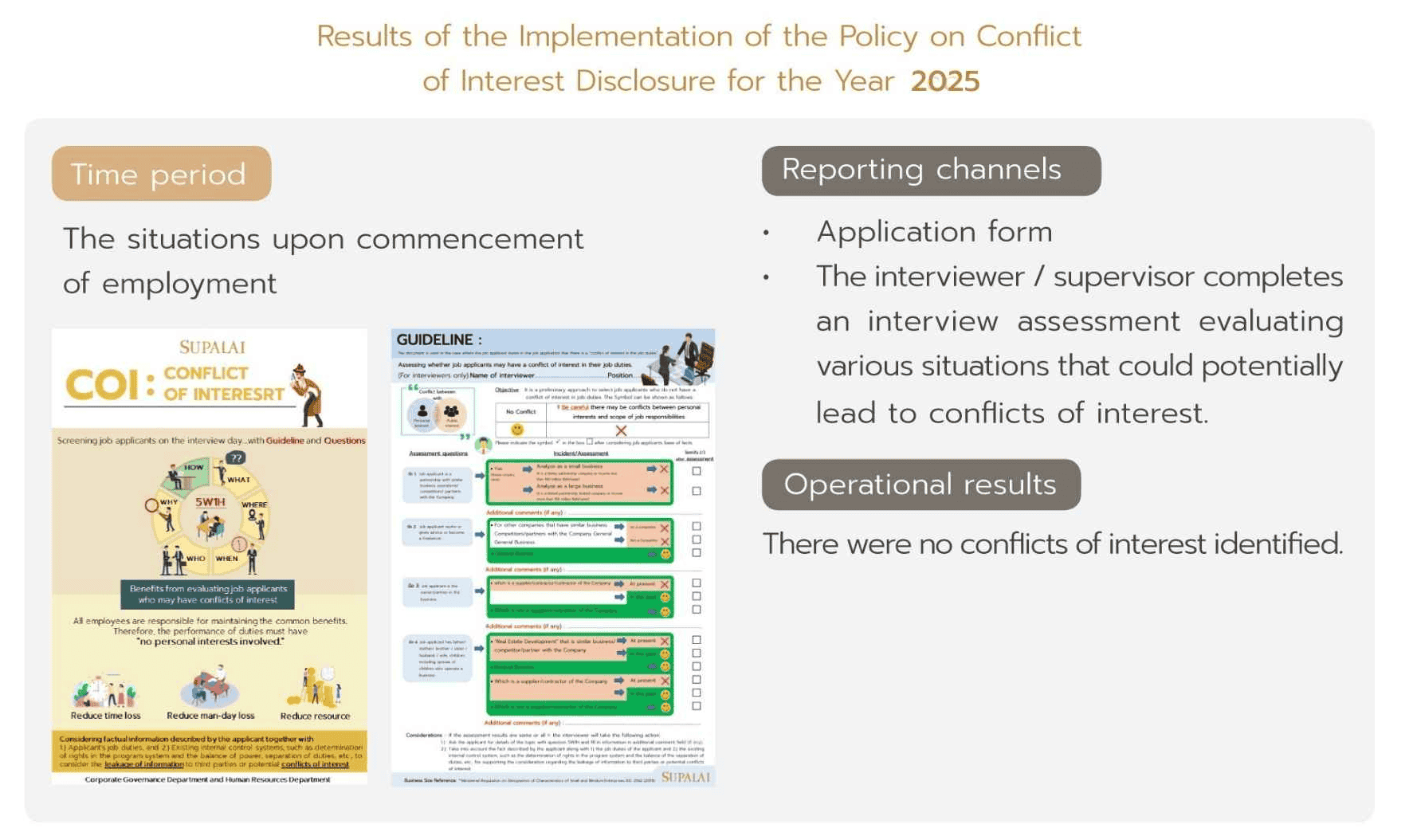
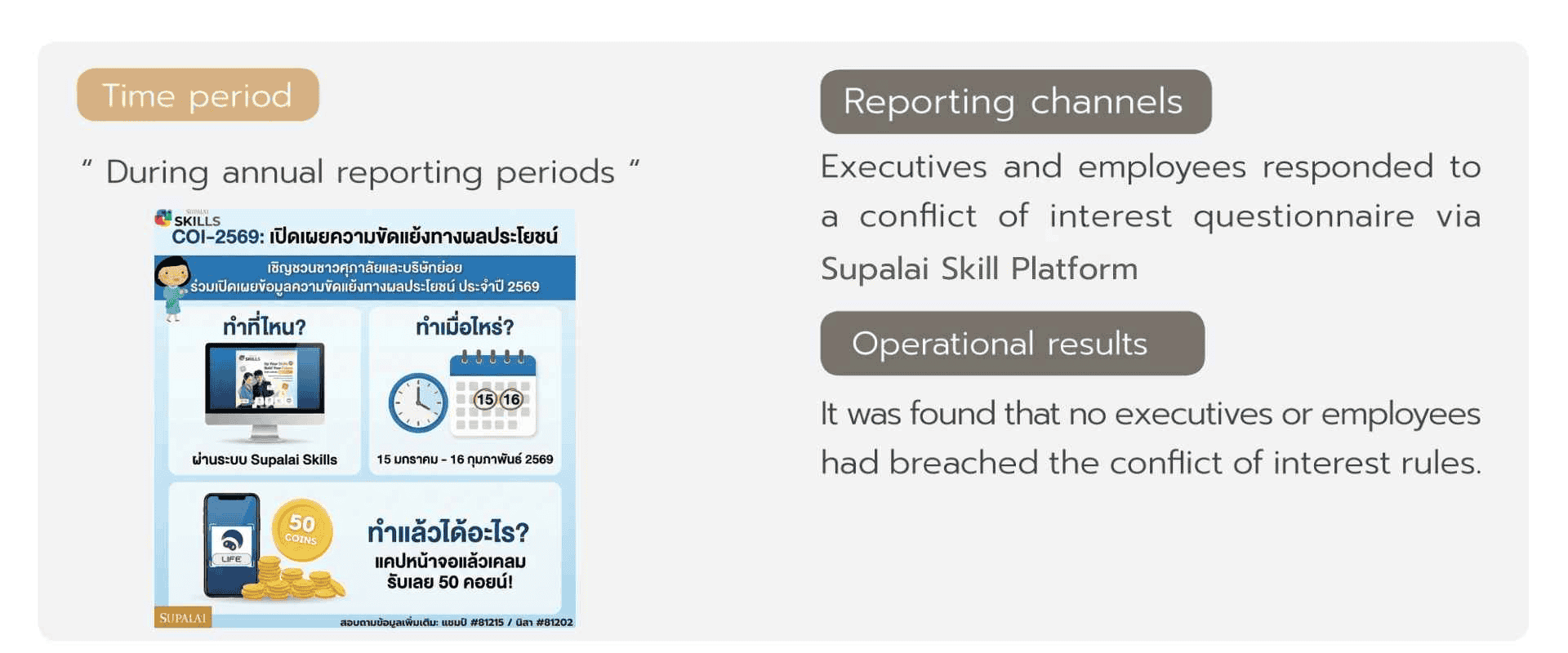
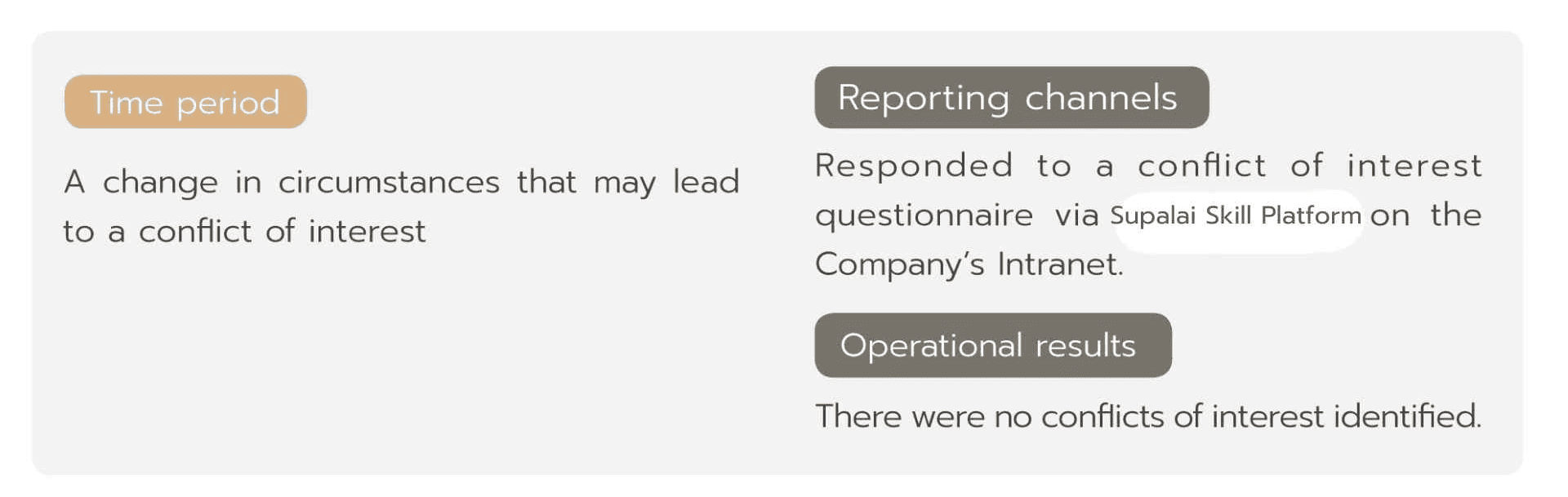

Number of Conflict-of-Interest Cases
| Metric | Current Year | Previous Year | Two Years Ago |
|---|---|---|---|
| Total number of cases or issues related to conflicts of interest (cases) | 0 | 0 | 0 |
Prevention of the Use of Inside Information
Has the Company Acted to Prevent the Use of Inside Information?
Yes
Operations in the Past Year
Exploitation of Insider Trading
The Company adheres to the policy on the use of inside information, which all directors, executives, and employees, including those in subsidiaries and affiliates, must strictly comply with. The policy requires directors and executives to report as follows:
Reporting the first shareholding of the Company and the change in securities holding, which includes spouses and children who are not sui juris as well as related persons under Section 59 of the Securities and Exchange Act, B.E. 2535 (1992), within 3 business days from the date of purchase, sale, transfer or acceptance of transfer to the Office of the Securities and Exchange Commission, Thailand. In addition, they are not allowed to trade in the Company's securities for 1 month prior to the publishment of the financial statements for the public.
Reporting the change in securities holding to the Office of the Securities and Exchange Commission of Thailand and submitting a copy of such report to the Company on the same date as the date of reporting to the Office of the Securities and Exchange Commission, Thailand.
When receiving material inside information that affects the change in securities price, the trading of the Company's securities must be suspended for one month prior to the publishment of the financial statements or such inside information for the public. Such material information must not be disclosed to any third parties.
If the directors and senior executives (executives as defined by the Securities and Exchange Commission, Thailand (SEC)) wish to trade-sell securities, the notice of intent shall be made at least 1 business day prior to the securities trading. The Board of Directors shall be informed by the Company Secretary. The securities holding report shall be prepared and submitted to the Securities and Exchange Commission, Thailand (SEC) within the specified period.
Results of the Implementation of the Policy on the Use of Inside Information for the Year 2025
Targets | Operational results |
once a quarter, total 4 times a year During two weeks before the closing date of financial statements, the Company Secretary will prepare a letter of notification to directors, executives and departments that acknowledge inside information to inform that they are not allowed to disclose inside information to any third parties or non-related persons and trade in the Company's securities for 1 month prior to the publication of the financial statements for the public and notify everyone in the Company via e-mail. | Achieved the target (Total 4 times a year) There were no findings of violations or non-compliance with the regulations regarding insider trading and asset trading as stipulated by the Stock Exchange of Thailand and the Securities and Exchange Commission. |
once a quarter, total 4 times a year The Board of Directors and executives report their securities holdings to the Board of Directors for acknowledgment in January, April, July, and October of each year, for a total of 4 times per year. | Achieved the target (Total 4 times a year) |
Furthermore, all directors, executives, and employees of subsidiaries and affiliates have signed acknowledgments and consents for the Company to use or disclose their personal data through the Employee Self Service (ESS) system. The Company places importance on and complies with the Personal Data Protection Act, B.E. 2562. The Board of Directors has reviewed and approved a Personal Data Protection Policy for directors, executives, and employees to enhance operational standards in accordance with external regulatory agencies and to align with good corporate governance principles. Additionally, the Company has no transactions involving financial assistance, such as loans or loan guarantees, to general companies that are not subsidiaries. Directors or executives of the company have not engaged in insider trading and have not violated or failed to comply with the rules on related party transactions and asset trading.

Number of Inside-Information Cases
| Metric | Current Year | Previous Year | Two Years Ago |
|---|---|---|---|
| Total number of cases or issues related to the use of inside information to seek benefits (cases) | 0 | 0 | 0 |
Anti-Corruption
Has the Company Acted on Anti-Corruption?
Yes
Operations in the Past Year

Messages from the Chief Executive Officer on Anti-Corruption Measures
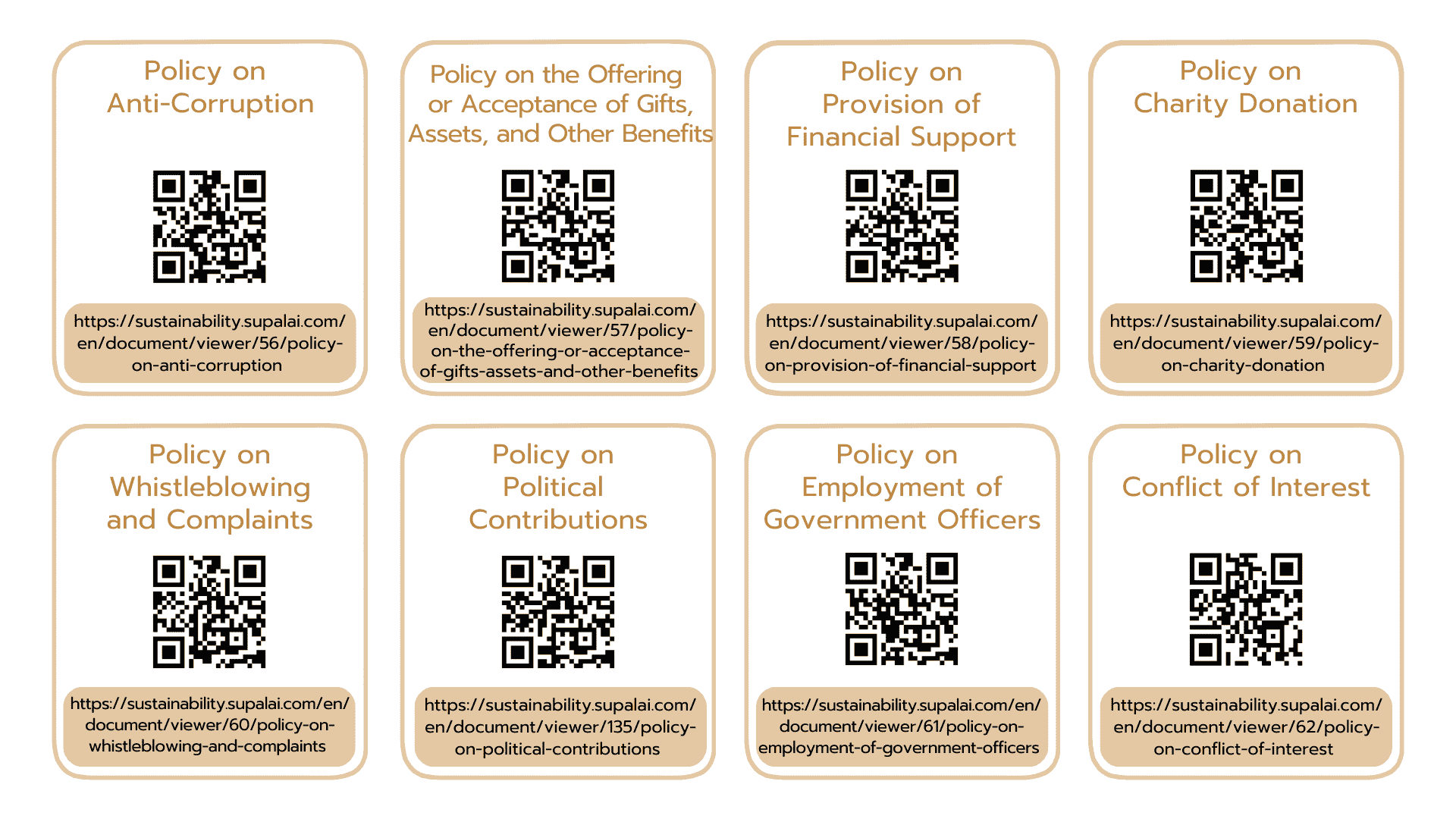
The Company recognizes that "corruption" is a social menace that adversely affects the Company's sustainability, as well as the economy, society, politics, and international confidence. Therefore, the Company has established eight policies related to anti-corruption measures, focusing on instilling awareness in employees and executives at all levels about the dangers of corruption and creating the right values to develop a transparent organization. This also aims to build confidence in conducting business together between the organization, investors, financial institutions, and business partners, which will increase the organization's competitiveness in both the short and long term. These policies have been approved by the Board of Directors, which has assigned the Audit Committee to oversee compliance with anti-corruption measures and designate those responsible for establishing written rules, methods, monitoring, and reporting with transparent disclosure and readiness for inspection in all processes, ensuring sufficient and effective measures to reduce potential risks from corruption.
The Company communicates its policies related to anti-corruption measures to directors, executives, supervisors, and employees of the Company and its subsidiaries through e-mail, Group Line, and bulletin boards at various locations within the head office and at all project offices. New employees are informed of the anti-corruption policies and practices immediately upon commencing work and receive training during every new employee orientation. The Company also disseminates information to external parties and all business partners and provides channels for reporting or complaining about corrupt practices, with measures to protect whistleblowers who report such activities. The Company has established eight policies related to anti-corruption measures, as follows:
1. Policy on Anti-Corruption
The Company complies with the anti-corruption policy. The Company operates its business by using fair and transparent business competitive strategies and mainly adhering to the good quality of products. The Company does not accept any corruption at all, whether by presenting, promising, asking, claiming, offering, or receiving bribery, inducing an illegal act, or destroying trust. Officers at all levels, including directors, executives, supervisors, and employees working for the Company, its subsidiaries, or other companies controlled by the Company, including persons involved in the business operation, are required to comply with such anti-corruption policy in all relevant departments and all localities where the Company operates its businesses.
In addition, the Company also establishes detailed procedures for anti-corruption so that the implementation is in accordance with the policy. However, the Company will review the procedures regularly to be in line with changes in laws and businesses and also maintain the Company's reputation.
2. Policy on Gift and Hospitality
The Company legally operates its business with integrity to maintain its reputation. The Company establishes a no gift policy regarding accepting and offering gifts, assets, or other benefits that can be done according to tradition and morality to express gratitude or maintain a normal business relationship. However, if the acceptance and the offering of a gift, asset, or other benefits are inappropriate, which may affect the decision of the performance of duties and cause the Company to lose benefits, the Company will not support such action.
3. Policy on Provision of Financial Support
The Company abides by the policy on the provision of financial support with commitment to business operations together with continuous corporate social responsibility to conduct business transparently. The Company establishes procedures and supervises the provision of financial support by reviewing the transaction approval from the Company's authorized persons, including reporting results and following up on the results of the provision of financial support to ensure that the financial support provided by the Company has been used according to the purpose of the financial support request.
4. Policy on Charitable Donation
The Company complies with the policy on charitable donation by focusing on business operations together with continuous corporate social responsibility to conduct business transparently. The Company establishes procedures and supervises transactions of charitable donation by reviewing the transaction approval from the Company's authorized persons, including reporting results and following up on the results of charitable donation to ensure that the financial support provided by the Company has been used according to the purpose of the charitable donation request.
5. Policy on Whistleblowing and Making Complaints
The Company establishes and complies with the policy on whistleblowing or making complaints by providing a channel for whistleblowing or making complaints due to an illegal or unethical act and behavior possibly implying corruption or misconduct of persons in the organization, including employees and all groups of stakeholders. In addition, the Company provides a mechanism to protect informants and pays attention to the confidentiality of complaints to build the confidence of complainants. Procedures, fact investigations, and summaries, including protection measures for whistleblowers or complainants, are clearly established for not suffering from trouble. They can perform whistleblowing or make complaints via e-mail: anti-corruption@supalai.com or a suggestion box installed at the fire exit of each floor at Supalai Grand Tower Rama III, which is reported directly to the independent directors.
6. Policy on Political Contribution
The Company complies with the policy on political contribution and supports democracy by encouraging all directors, executives, and employees, including employees of companies controlled by the Company, to exercise their political rights in accordance with the laws as good citizens and express, join, support, and exercise political rights outside working hours by using their own resources only. The Company has no policy for supervisors and employees at all levels to instruct or influence others by any means, which causes employees and subordinates to participate in all types of political activities that may lead to internal conflicts.
7. Policy on Employment of Government Officers
The Company complies with the policy on employment of government officers by selecting and recruiting personnel who have been government officers according to the criteria set by the Company in order not to avoid the exploitation of such actions as a return for the acquisition of any benefits. In addition, information is disclosed for transparency and traceability.
8. Policy on Conflict of Interest
The Company complies with the policy on conflicts of interest by providing a channel for the Company's personnel to report conflicts of interest to the Audit Committee to ensure that the Company's personnel perform their duties by adhering to the Company's benefits under lawfulness and ethics. The Company's personnel must strictly avoid having any personal interests that will adversely affect the performance of duties for the benefit of the Company according to the specified policy on the prevention of conflicts of interest.
In 2025, the executives and employees of the Company and its subsidiaries signed acknowledgments of the anti-corruption policy through the SPL Consent Management system, an online signing system. This system allows for the retrieval of various reports, such as the number of policy acknowledgments, the number of users who accessed the Company's policy information, and more. It serves as a management tool to raise employee awareness and foster a unified approach to combating corruption, passing down practices from generation to generation until it becomes a strong corporate culture. Details related to the aforementioned policies can be found on the Supalai Public Company Limited website.
Provision of Knowledge of Anti-Corruption Measures to All Directors, Executives, Supervisors and Employees
The Company offers training to all new employees to provide knowledge on anti-corruption measures at the employee orientation and issues press releases to provide knowledge on anti-corruption through public relation boards, Line Group, and e-mails to employees of the Company and its subsidiaries. In addition, activities are held to create a culture that supports the organization's anti-corruption, such as an annual anti-corruption knowledge test, bulletin board decoration for providing knowledge, which receives positive feedback from employees. The managing director also emphasizes that all employees must acknowledge the benefits of anti-corruption at the Company's annual New Year's party. Regarding the provision of knowledge on anti-corruption measures to directors and senior executives, information on anti-corruption policy, practices, results of policy implementation, manual on implementation of policies on anti-corruption measures, and benefits are presented to the Management Committee, the Executive Committee and the Board of Directors.
Chairman of the Executive Committee gave the speech about the benefits of anti-corruption
at the Company's New party

Communication and Training to Employees and Stakeholders
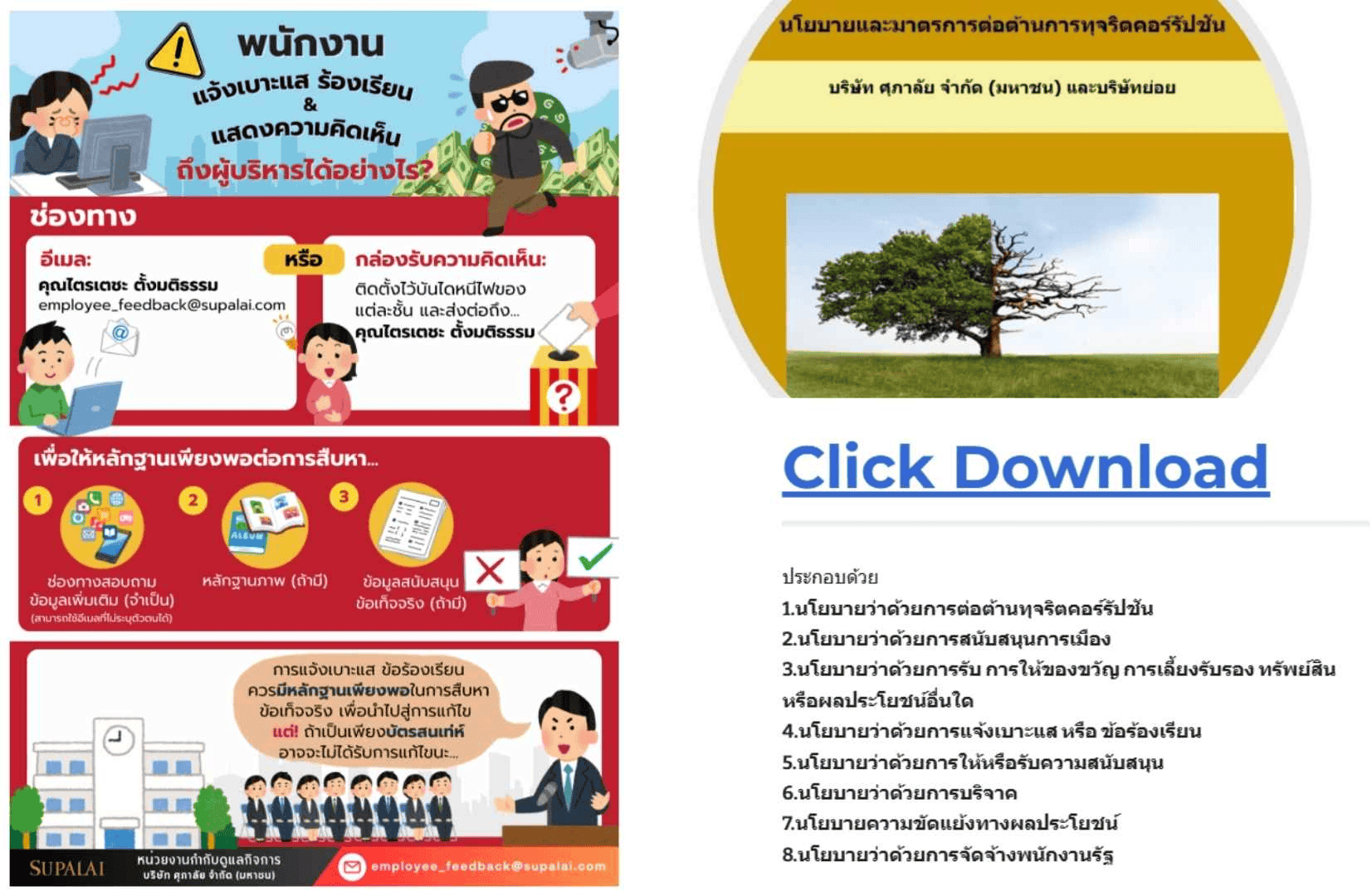
The Company disseminates anti-corruption measures to all employees via public relations boards, e-mail, the Company's Intranet and also communicates such measures to all groups of stakeholders, such as shareholders, business partners, competitors, customers, contractors and stores, through the Company's website (www.supalai.com). It is considered to compliance with the policy on the treatment of customers and business partners. The Company does not request or receive any dishonest benefits and accept gifts in any festivals. In addition, risk management on corruption is also provided. The Management sends a letter to suppliers so that they can use such channel to perform whistleblowing via the e-mail: anti-corruption@supalai.com. However, this is to communicate the Company's policies and practices on corruption prevention to stakeholders and allow them to know the channels for whistleblowing and create participation from stakeholders to make the Company's commitment to corruption prevention achieve its specified objectives. Not only are the employees of the Company aware of the practices on anti-corruption, but the Company also provides communication to applicants who are interested in working with the Company in the job application form and when interviewing applicants about attitudes on anti-corruption.
Communicating anti-corruption policy and measures and whistleblowing channels through the Intranet system
Assessment of Risk on Business Corruption
The Company conducts a corruption risk assessment in all departments of the Company and its subsidiaries. Each department identifies risks possibly arising from corruption, score level of opportunity and impact of risks, including approaches to minimize risks and measures on corruption prevention or anti-corruption. The risk assessor considers risks from the nature of business activities, operational processes, situations of the industry, business terms, including policies relating to anti-corruption measures and a manual on policies relating to anti-corruption measures that identify the specific procedures of each policy, such as receiving or offering gifts, providing subsidies or political actions. All directors, executives, supervisors and employees of the Company and its subsidiaries must strictly comply with these rules and policies communicated by the Company and trained employees.
In 2025, the Company did not detect any significant issues or defects regarding litigation on anti-competition, destruction of credibility, monopoly of trade, incidents of discrimination, and corruption. In addition, there were no fines or non-fine penalties due to inconsistent operations with applicable laws or regulations and violations of the Code of Conduct.
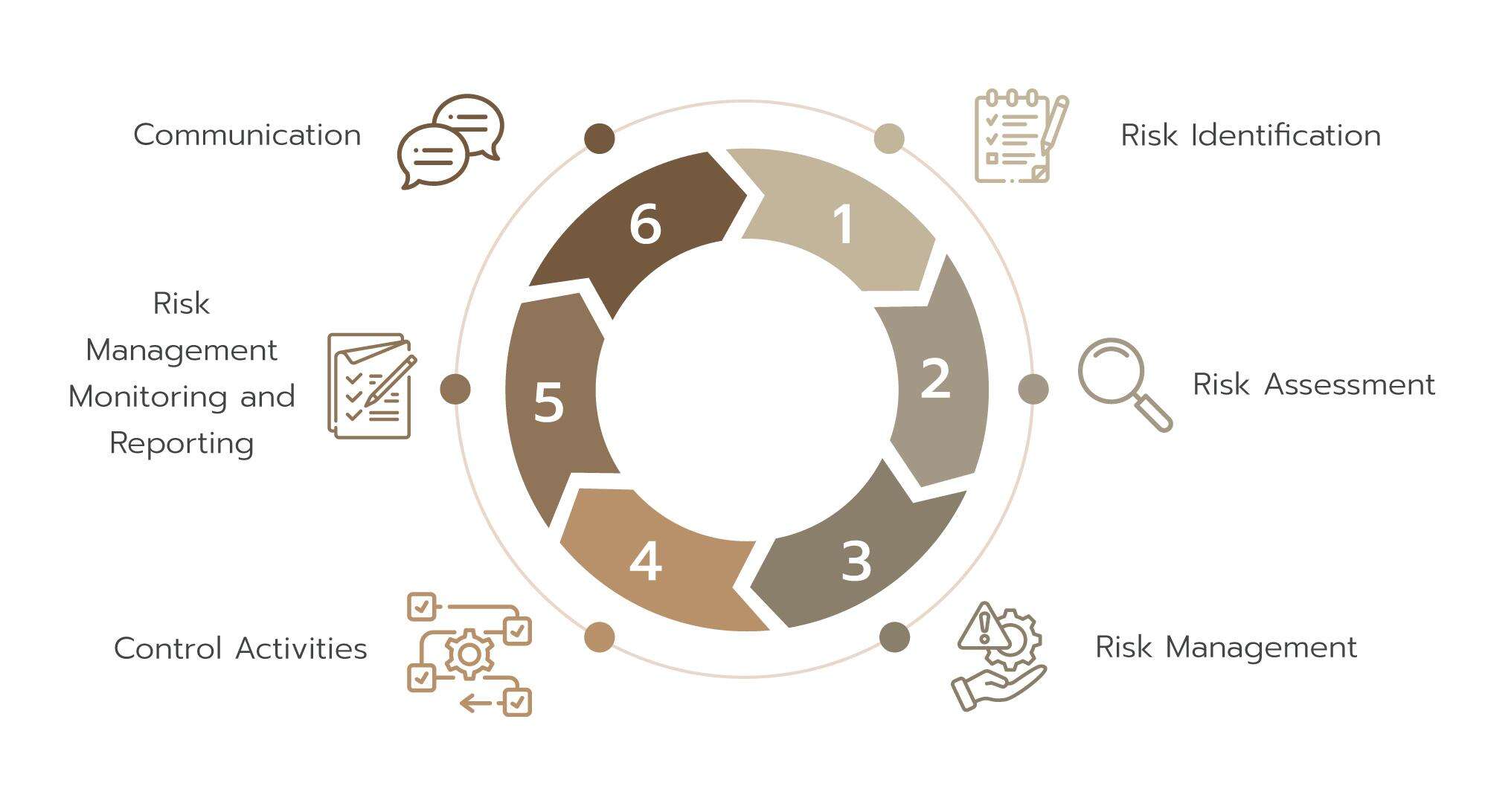
6 Steps for Risk Assessment
1. Risk Identification
Supervisors identify the potential corruption risks by taking the results into action
When planning an internal audit plan
When there is an Audit Checklist in the system audit process
2. Risk Identification
The assessor identifies the severity of the risk and how it affects the achievement of the objective by considering the level of likelihood and impact that may arise from risks. When encountering issues / findings that the risk is medium, high, or very high, the risk management plan and risk appetite shall be reported to the Audit Committee, Risk Management Committee, Corporate Governance and Sustainability Development Committee.
3. Risk Management
Defining strategies or activities to manage risks in accordance with risk appetite of the Company.
4. Control Activities
A policy or practice is applied to implement a control, such as approval, review, reconciliation, separation of duties, to ensure that risk management has been performed appropriately and timely.
5. Risk Management Monitoring and Reporting
Monitoring and improving risk management activities to ensure continuity and appropriateness of the situation by collecting and presenting corruption risk information to the Audit Committee, the Risk Management Committee, and the Board of Directors for consideration and approval at least once a year.
6. Communication
Risk management is communicated according to the opinions of the Audit Committee and the Board of Directors and then notified to the relevant department. Issues / findings are communicated to each department as follows:
Internal Audit and Corporate Governance Section
Risk Management Section
Quality System Section
Establishment of Guidelines for Control, Prevention, and Monitoring of Risks on Corruption
The Chief Executive Officer leads the organization by setting an example in the serious implementation of anti-corruption policies. By demonstrating exemplary behavior, they build confidence among all employees, encouraging collective efforts in combating corruption. All employees strictly adhere to the anti-corruption policy, demonstrating the company's commitment. This is achieved through the following actions:
Message from the Chief Executive Officer on Anti-Corruption Measures is informed to all groups of stakeholders to demonstrate their commitment to anti-corruption action.
Supports the Company's online knowledge test on anti-corruption measures and offers rewards to employees who obtain the highest score.
Supervising executives and supervisors to communicate corruption risks through project meetings, and providing cooperation in responding to survey forms and interviews with private companies on corruption issues of the Thai Institute of Directors (IOD).
It also establishes the procedures for recording and collecting statistical data on the number of whistleblowing, type of whistleblowing, number of whistleblowing being investigated and implemented, summary of investigation results of each complaint, including annual statistical reports on whistleblowing or complaints to the Audit Committee and the Board of Directors in writing. This is for the benefits of monitoring progresses and improvement of the Company's operational processes that may cause all forms of corruption.
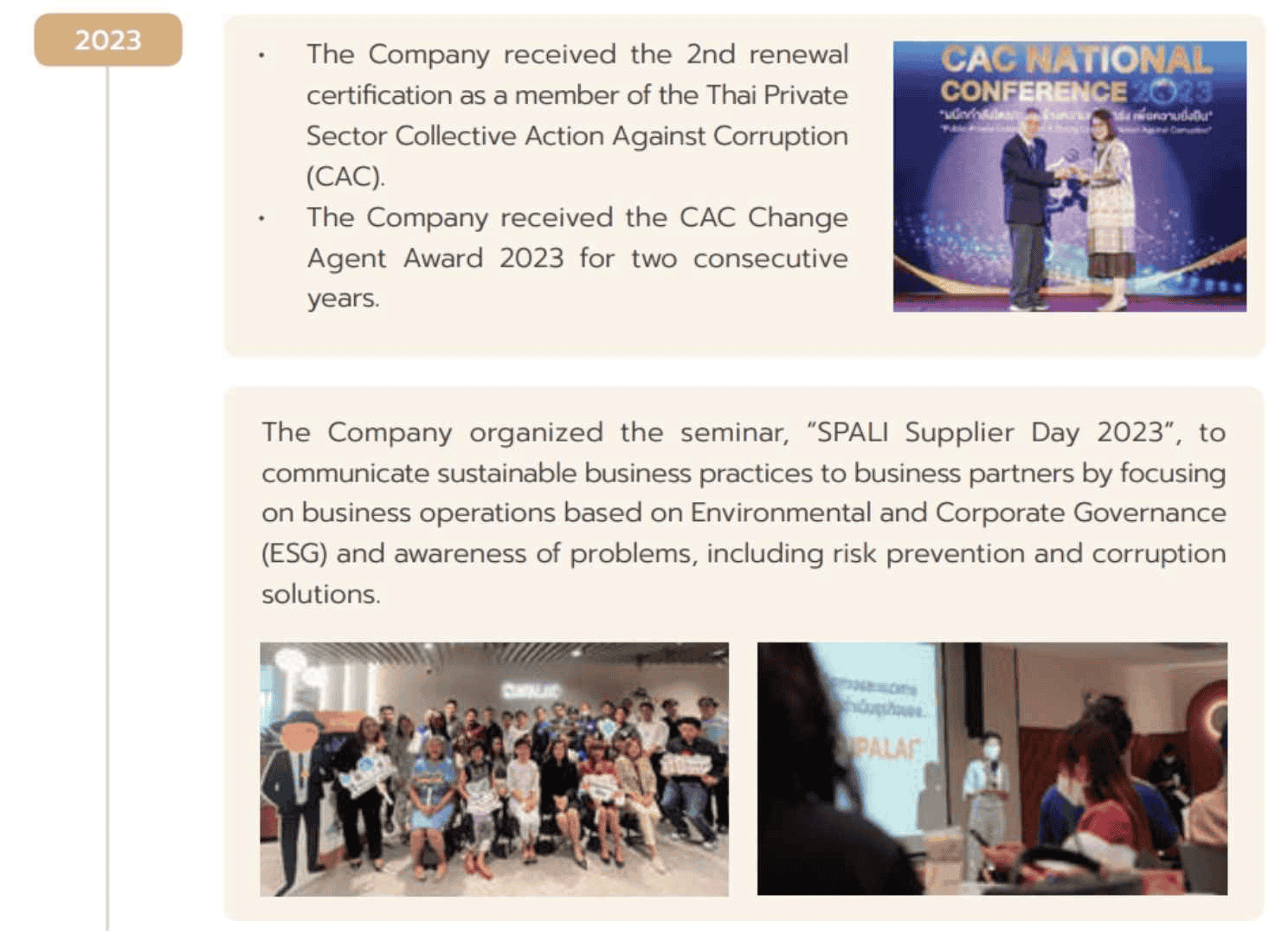
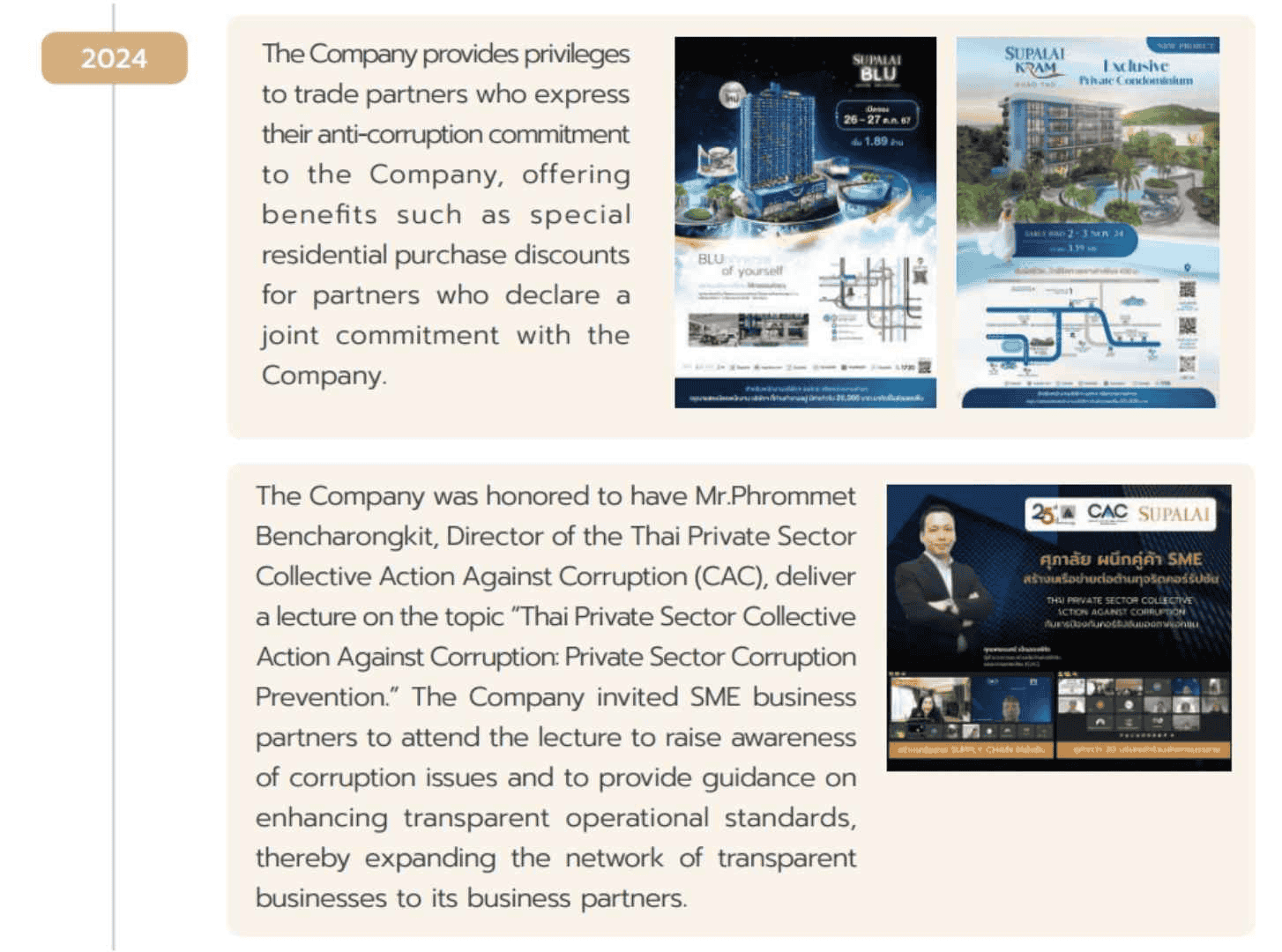
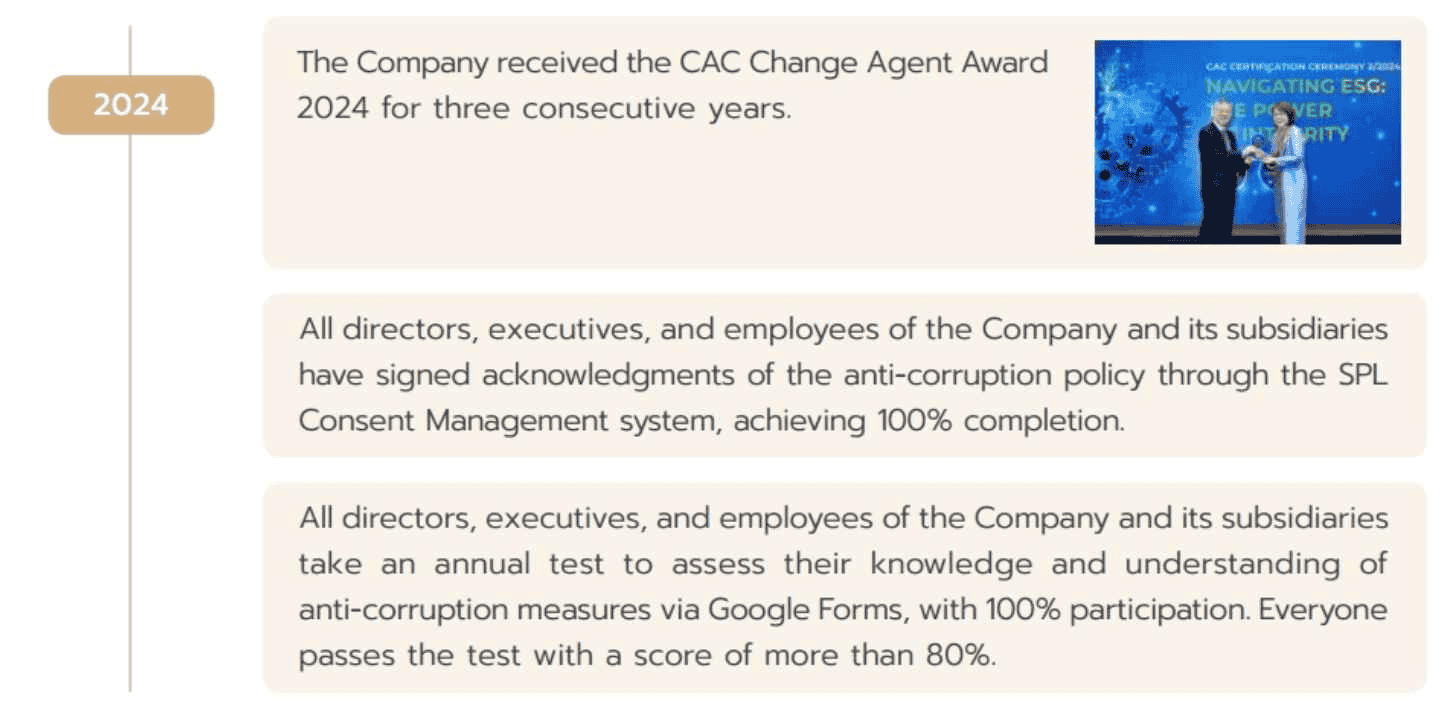
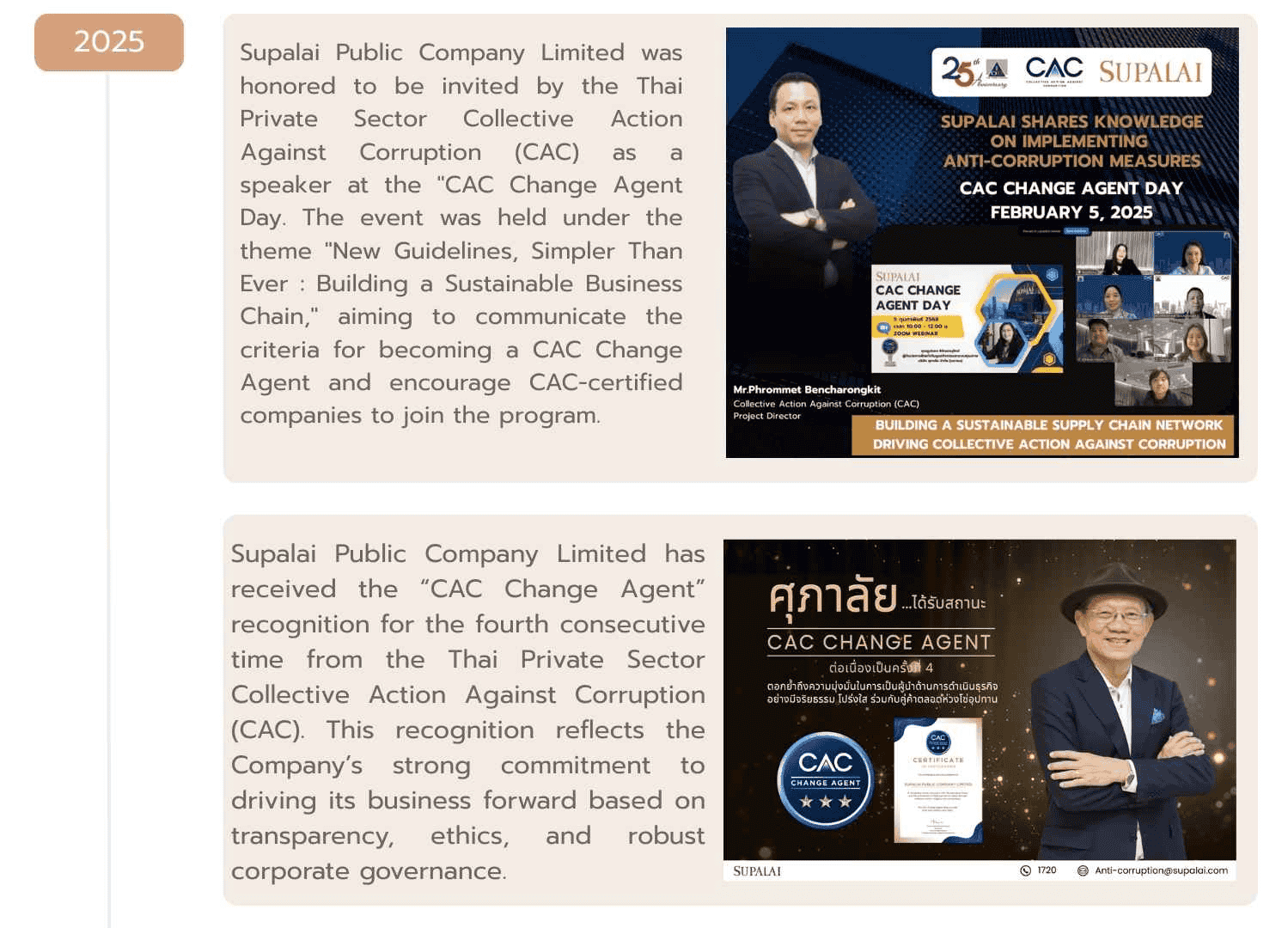
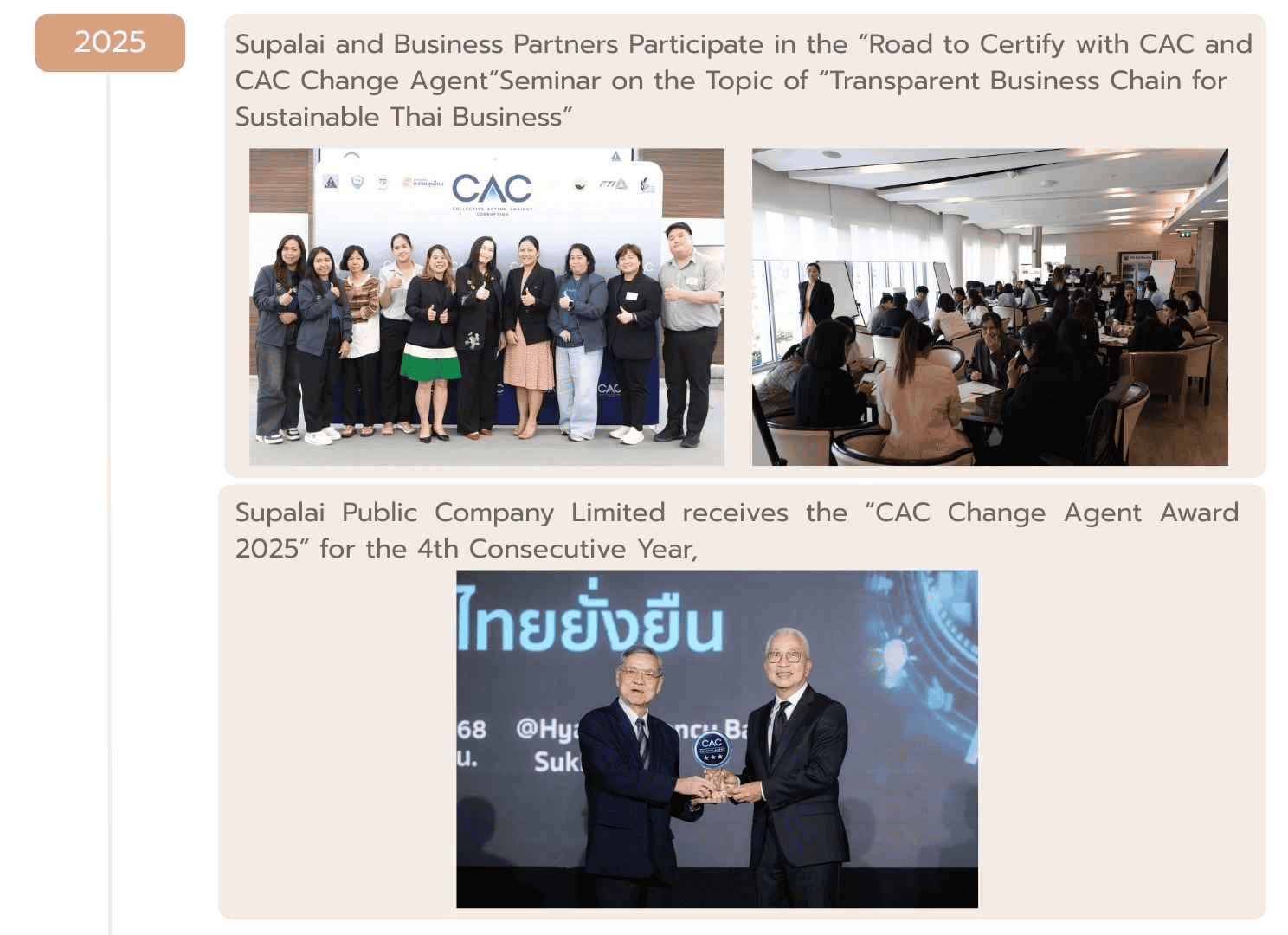
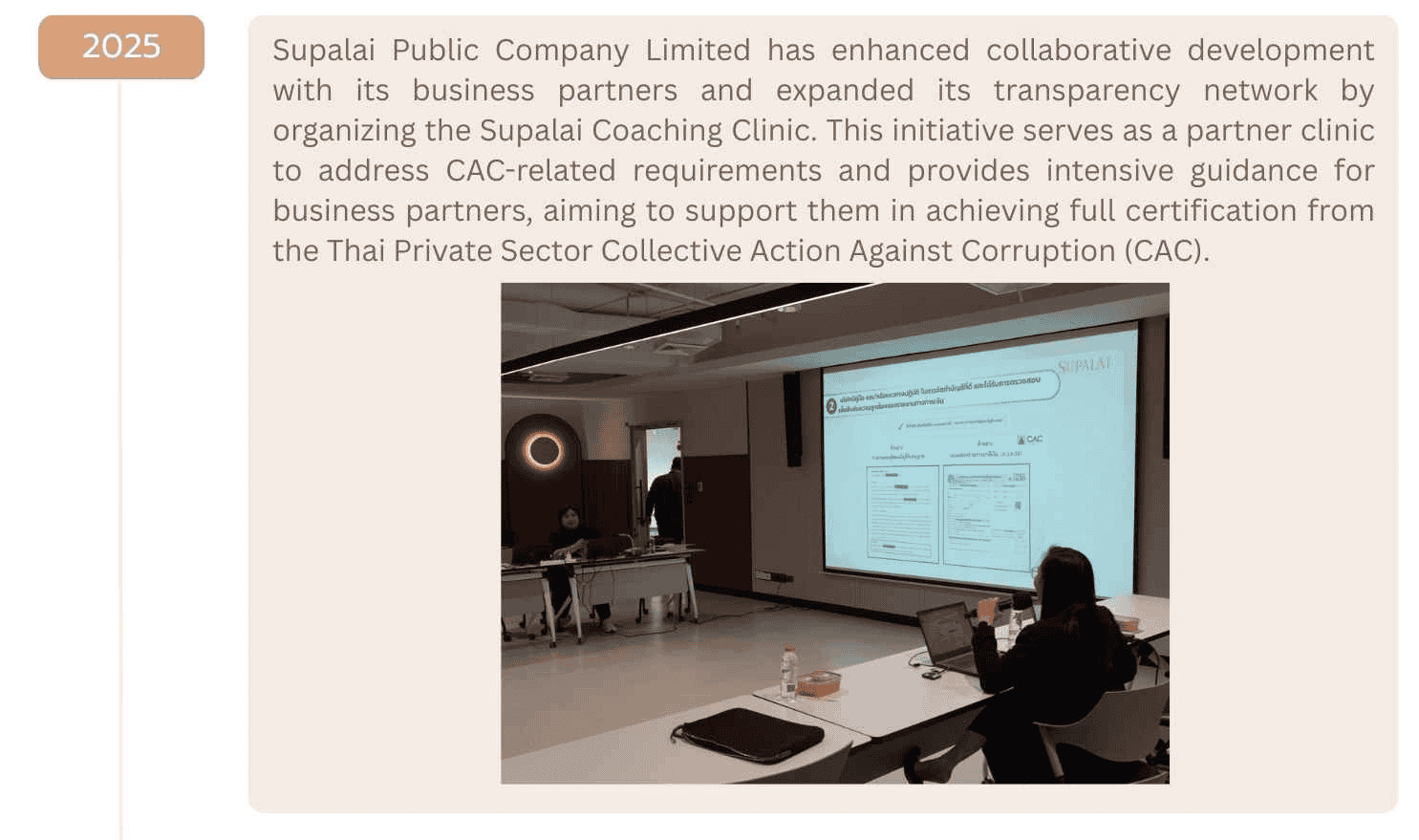
Driven by the commitment of the Chairman of the Executive Board under the supervision of the Audit Committee, as assigned by the Board of Directors, the Company has been certified as a member of the Thai Private Sector Collective Action Against Corruption (CAC). Furthermore, the Company has declared its participation as a CAC Change Agent member. Notably, the Company has been honored with the "CAC Change Agent Award" for the fourth consecutive year. The details of the anti-corruption operational guidelines are as follows:
Disclosure of anti-corruption practices
Over the past three years, anti-corruption operations have led to significant developments, as follows:
Form of Anti-Corruption Operations
| Operation |
|---|
| Review of appropriateness in anti-corruption |
| The participation in anti-corruption projects |
| Assessment and identification of corruption risk |
| Communication and training for employees on anti-corruption policy and guidelines |
| The monitoring of the evaluation of compliance with the anti- corruption policy |
| Review of the completeness and adequacy of the process by the Audit Committee or auditor |
Number of Corruption Cases
| Metric | Current Year | Previous Year | Two Years Ago |
|---|---|---|---|
| Total number of cases or issues related to corruption (cases) | 0 | 0 | 0 |
Whistleblowing
Introduction
Channel for Whistleblowing on Corruption
The Board of Directors establishes a channel for whistleblowing or complaints on illegal acts or offenses of corruption or ethical violations or behaviors that may imply corruption or misconduct of any individuals within the organization or violations of rights by employees and all groups of stakeholders (including partners, subcontractors, and employees). The stakeholders can perform whistleblowing or report complaints through the following channels:
E-mail: anti-corruption@supalai.com, which will be reported directly to independent directors
Suggestion boxes are installed at the fire exit of each floor
Making a complaint by calling 1720
Employees make a complaint / offer a comment directly to executives via employee_feedback@supalai.com

Has the Company Implemented Whistleblowing Procedures?
Yes
Operations in the Past Year
Complaint and Whistleblowing Process
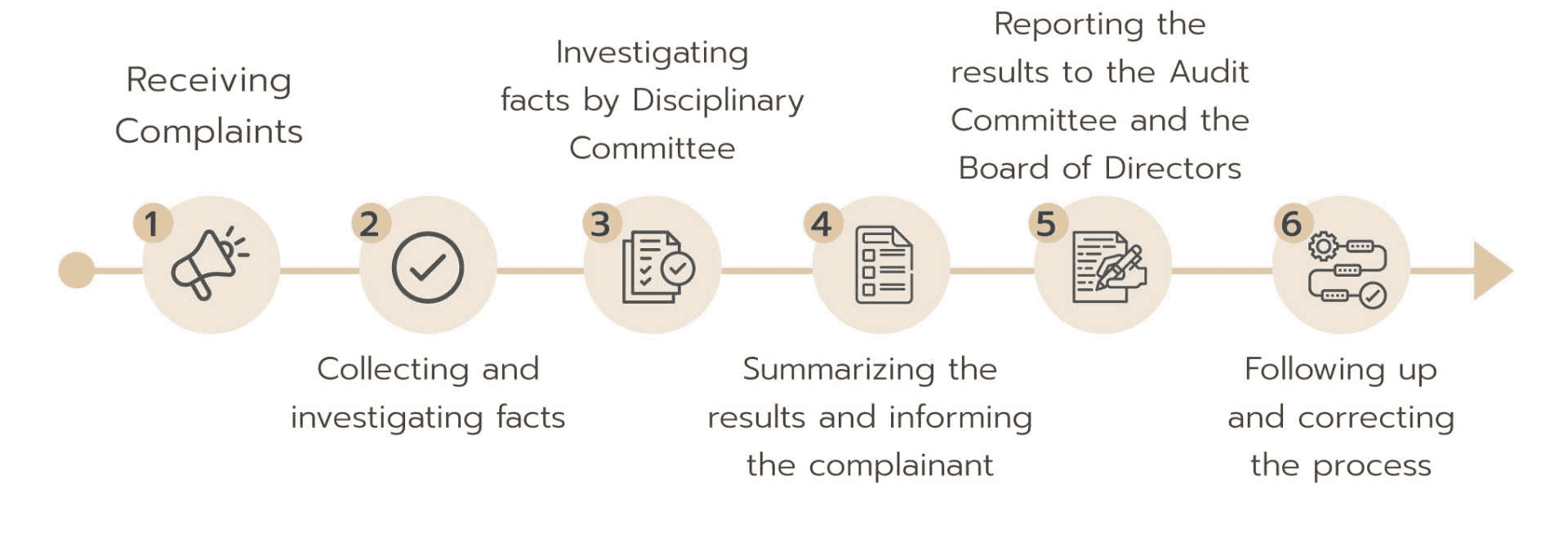
The company established the procedures for handling complaints on corruption as follows.
1. Acceptance of Matters
When whistleblowers or complainants report any corruption matters, the coordinator registers the acceptance of matters.
1) The complainant must be the person affected by the Company's operations and show his/her identity with evidence issued by government agencies for supporting the reporting of complaints.
2) The complainant provides written details of the complaint by describing the sequence of events in detail, including the date, time, name-surname, and the affiliated department of the referring person referring to.
2. Investigation
The Investigation Committee is appointed to conduct the investigation and summarize its results and then present it to the Audit Committee.
3. Reporting Results
The Internal Audit Department summarizes details of complaints, investigations, and consideration results and presents them to the Audit Committee. The Audit Committee summarizes the consideration results and expresses opinions and reports to the Board of Directors.
4. Reporting Results to Whistleblowers or Complainants
The consideration results are notified to the whistleblowers or complainants after reporting such investigation results to the Board of Directors.
5. Monitoring and Reporting
In the case that the Audit Committee or the Board of Directors provides any suggestions or comments on the improvement of procedures for corruption prevention, the Internal Audit Department is responsible for monitoring and reporting the results of improvement and correction to the Audit Committee and the Board of Directors for acknowledgment.
Measures for Protection of Whistleblowers or Complainants
The Company established a policy on the protection of whistleblowers or complainants regarding corruption as follows:
The Company will keep information and identity of the whistleblower or complainant and the person being complained confidential.
The Company will disclose only necessary information by considering the safety and the damage of the reporter, the source of information or related persons.
Those affected will be mitigated through appropriate and fair procedures.
In the case that whistleblowers or complainants or those cooperating in the investigation think that they may be in danger or may suffer from damages, whistleblowers or complainants or those cooperating in the investigation can request the Company to establish appropriate protection measures or the Company may establish protection measures without the request of the complainants or those cooperating in the investigation if it is considered that such matter is likely to cause damages or dangers.
The Company will not take any unfair action to the whistleblower or complainant, such as changing their job position, job description, place of work, suspension of work, threatening, interference with operations, termination of employment or any other acts that are unfair to the whistleblower or complainant or those cooperating in the investigation.
The Company does not demote, punish or give negative effects to employees who refuse to be involved with corruption in a practical manner.
Number of Whistleblowing Cases — Introduction
Procedures for Concrete Operations
1. Establishment of Policy: The Company establishes the written anti-corruption policy by requiring all directors, executives, supervisors and employees including employees of the Company and its subsidiaries to strictly comply with it.
2. Monitoring and Evaluation of Performance: The Company assigns the Internal Audit Department to monitor and evaluate results and comply with anti-corruption measures, including improving operational processes in accordance with the relevant policies. Guidelines for monitoring and evaluating the compliance with anti-corruption measures are established. The work process is reviewed in each procedure to identify deficiencies in the internal control system that could potentially lead to corruption in order to seek preventive measures and establish them as practices.
3. Improvement of Work Process: In addition to the application of results of the work process review to improve procedures, the Audit Committee and the Board of Directors’ opinions on the review of the completeness and sufficiency of the work process are also applied from the investigation results, complaints from the corruption risk assessment, as well as opinions of all employees through the specified e-mail channel. They are applied to the improvement of the relevant processes, practices and policies to minimize the risk from corruption.
4. Monitoring of Work Process Improvement: Following up the improvement results and summarizing the improvement results to ensure that suggestions presented to improve processes, practices and policies have been put into operation in a timely manner.
5. Results Reporting: The Internal Audit Department reports monitoring results and evaluation results of anti-corruption measures, including suggestions on the implementation and improvement results to the Audit Committee annually so that the Audit Committee can review the completeness, appropriateness, and sufficiency of the processes, practices and policies relating to anti-corruption measures. The Audit Committee is responsible for reporting the review results to the Board of Directors. However, if the Audit Committee and the Board of Directors provide any suggestions, the Company will apply them to improve the relevant processes, practices, and policies to enhance the efficiency of internal control.
Corrective procedures to prevent the recurrence of violations of the Code of Conduct
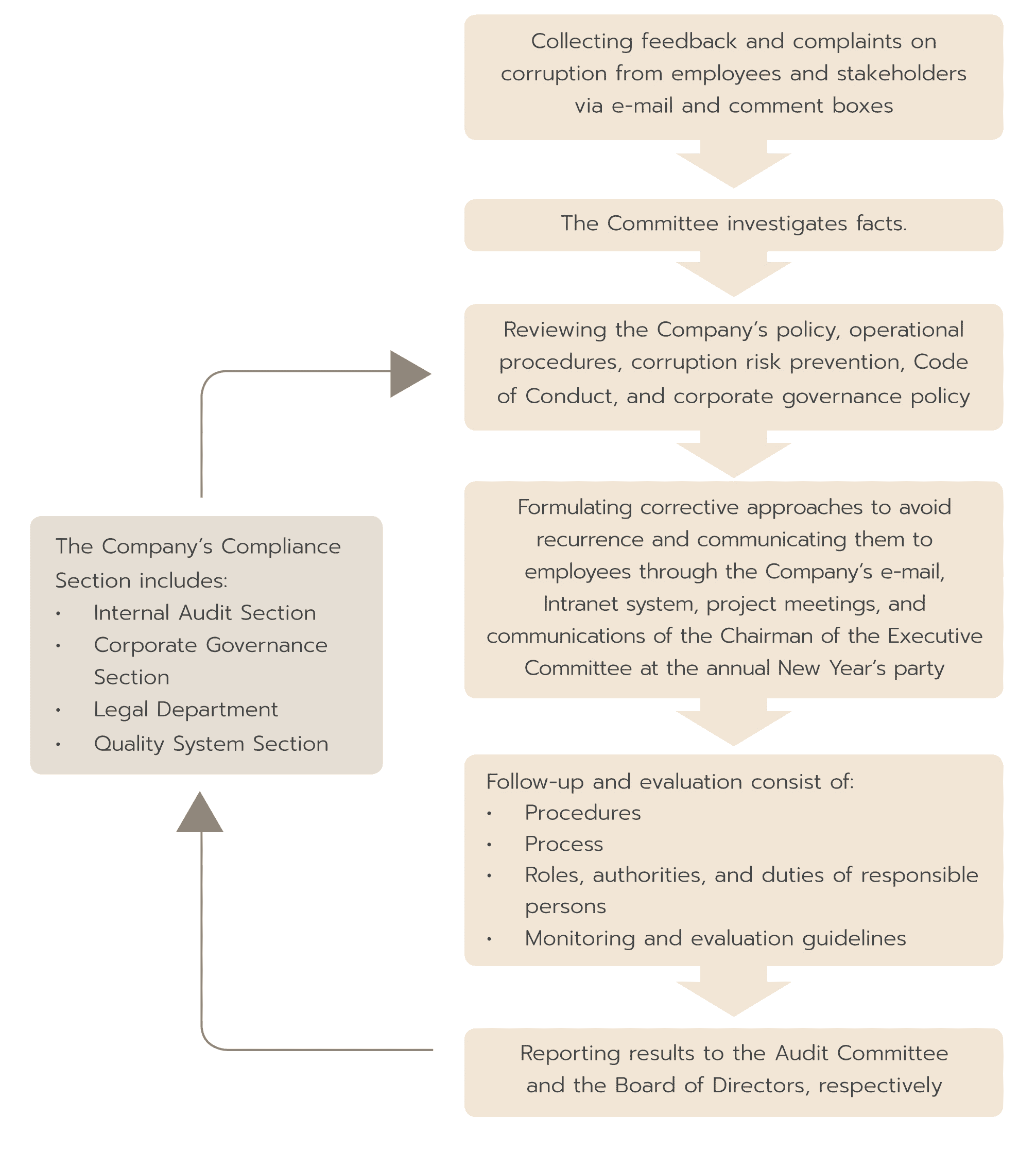
Review of Completeness and Sufficiency of Anti-Corruption
The Company assigns the Audit Committee to conduct a review of completeness and sufficiency to prevent any involvement with corruption as follows:
The Company establishes an anti-corruption policy which all directors, executives, supervisors and employees including employees of the Company, its subsidiaries or other companies controlled by the Company must comply with. It is also identified in the Code of Conduct for directors, executives, and employees of the Company, which must be strictly abided by.
The Audit Committee is responsible for supervising and reviewing the compliance with anti-corruption measures under the management's control, prevention and monitoring of risks from corruption, which policies and guidelines are clearly established and reporting the results to the Board of Directors.
The Company provides an efficient internal control system, covering finance and accounting and the assessment of the sufficiency of the internal control system to the Audit Committee annually and establishes procedures for storage of documents and records in accordance with the specified accounting standards.
The management supports the provision of knowledge on compliance with anti-corruption measures to employees and expresses the intention and commitment to corruption prevention to all employees of the Company, its subsidiaries, other companies controlled by the Company and all groups of stakeholders.
The Company provides the channel for whistleblowing or making complaints in the event that any corruption is found. Measures to protect whistleblowers, complainants or persons cooperating in providing such information are established. In addition, they are able to suggest, comment and ask questions about anti-corruption measures via e-mail: anti-corruption@supalai.com Employees can make complaints / express their opinions directly to executives or put suggestions in the suggestion box installed at the fire exit of each floor.
The Company conducts corruption risk assessments in all departments of the Company and its subsidiaries.
The Company appoints a working group to develop the anti-corruption system by requiring employees to participate in driving, promoting, and developing compliance with anti-corruption measures in the organization.
The Company organizes activities to campaign against corruption, such as disseminating anti-corruption policies to all groups of stakeholders through the company's website (www.supalai.com) and to all employees via e-mail and the company's Intranet. Additionally, the Company provides orientation to new employees to provide knowledge on anti-corruption policies and practices, issue press releases to provide knowledge on anti-corruption measures, shares case studies to enhance understanding of the policy, and provides knowledge tests on anti-corruption.
Number of Whistleblowing Cases
| Metric | Current Year | Previous Year | Two Years Ago |
|---|---|---|---|
| Total number of cases or issues received through whistleblowing channels (cases) | 1 | 1 | 1 |
Details of Whistleblowing Cases
| Status | Period Type | Start of Period | End of Period | Details of the Case or Issue | Investigation Results | Corrective Actions | Case or Issue |
|---|---|---|---|---|---|---|---|
| Incident no longer subject to action | Within (month/year) | 2025-10 | 2025-10 | An employee assigned to a project demanded that the project contractor under his/her supervision provide alcoholic beverages and meals as a form of benefit in return when the contractor received a progress payment from the Company. | An employee assigned to a project demanded that the project contractor under his/her supervision provide alcoholic beverages and meals as a form of benefit in return when the contractor received a progress payment from the Company. | Actions Taken
1. The Project Construction Manager informed the regular project meeting, attended by project staff, that such conduct constitutes a violation of the Company’s Code of Conduct and is contrary to the Company’s Anti-Corruption Policy.
2. The direct supervisor summoned the employee to receive a formal warning and strictly instructed him/her not to repeat the misconduct.
Corrective and Preventive Measures to prevent recurrence:
1. Senior management communicated the Company’s anti-corruption culture and zero-tolerance stance to all employees through the annual New Year staff event.
2. All employees are required to acknowledge and sign their compliance with the Company’s Code of Conduct, including all related corporate policies. The Company has also implemented a knowledge assessment system to enhance employees’ understanding and proper conduct in accordance with the Code of Conduct while reinforcing awareness of the whistleblowing channels available for reporting misconduct. | 3198 · Description: Whistleblowing and Protection of Whistleblowers |
Selection of Directors & Chief Executives
Selection — Introduction
The Company has appointed the Nomination and Compensation Committee to consider selecting and screening the persons nominated for appointment as directors, taking into consideration the proper proportion, numbers and composition. The Nomination and Compensation Committee shall consider selecting qualified persons who do not possess any prohibited characteristics pursuant to the Company’s Articles of Association for recommendation to the Board of Directors so that the Board will nominate such persons to be elected on an individual basis in the Annual General Meeting of Shareholders.
The Nomination and Compensation Committee set the new criteria and process for director nomination in a systematic manner as follows:
The Company provides for small shareholders to nominate the names of suitable persons or consider the persons from the director pool or consider existing directors to be re-appointed, or each director proposes the name of suitable persons to be appointed.
Select and screen the persons with suitable qualifications to be directors, such as suitable knowledge, experiences and specific ability corresponding to the business operation strategy of the Company, which is in line with the Board Skill Matrix.
Examine list of names of nominated persons if they possess the qualifications according to the laws and requirements of regulatory agencies.
Consider the dedicated time of directors, their stake or conflict of interest with the Company in case of re-appointment for another term of office by taking into account the performance of duties while serving their terms, their provision of beneficial recommendations, opinions and participation in various activities including strictly limiting the directorships in listed companies to no more than 5 listed companies without exception, to ensure that their efficiency will not decrease.
In case of appointment of independent directors, their qualifications must be in line with the criteria adopted by the Company, which is stricter than those adopted by the Capital Market Supervisory Board.
Prepare the list of names already considered and screened by the Nomination and Compensation Committee including their qualifications in an orderly manner to be proposed to the Board of Directors to be further proposed to the ordinary shareholders’ meeting to consider one after another.
In 2025, the Board of Directors carefully and prudently considered and screened the list to ensure that the persons nominated met the Company's good corporate governance practices. They must be a qualified person with background and expertise from various professions, leadership, wide vision, morality, ethics, and transparent work experiences. They must be a director who applies experiences, knowledge, and expertise to provide useful suggestions in formulating the Company's strategies and business operations according to sustainable development guidelines. In addition, the Nomination and Compensation Committee also provided opportunities to shareholders to participate in the nomination of qualified directors.
Directors & Chief Executives — Introduction
Director Nomination
In the appointment of directors, the Nomination and Compensation Committee, which consists of two independent directors out of a total of three members, is responsible for considering, selecting, and screening individuals who possess appropriate qualifications in accordance with the Company’s Articles of Association. The Committee nominates suitable candidates in order to ensure a professional and diverse Board of Directors, taking into account the Board’s structure, size, and composition. The number of candidates proposed shall be equal to one-third of the directors whose terms are due to expire. The Nomination and Compensation Committee then submits its recommendations to the Board of Directors for approval, after which the proposed directors are presented to the shareholders’ meeting for election in accordance with the prescribed criteria and sequence.
The Nomination and Compensation Committee considers the nature of the Company’s business and its future plans and, accordingly, defines the required qualifications of directors. This is to ensure that the Board of Directors as a whole possesses comprehensive knowledge, capabilities, and professional skills in line with the established criteria, and to serve as a benchmark for the development of directors’ competencies that will be beneficial to the formulation of the Company’s strategies, policies, and business directions.
Accordingly, the Company has set a target that the overall expertise level of the Board structure shall be not less than 80% for the annual performance evaluation. In addition, the Nomination and Compensation Committee provides shareholders with an opportunity to participate by proposing qualified candidates for directorship.
Nomination of the Chief Executive Officer
The Board of Directors has considered and assigned the Nomination and Compensation Committee to determine the criteria and procedures for selecting suitable individuals to assume the position of Chief Executive Officer and to propose qualified candidates together with supporting reasons for the Board’s consideration and appointment. In the nomination process, the Committee screens and selects individuals who possess complete and appropriate qualifications, knowledge, and capabilities, with experience in real estate development management, leadership qualities, and a broad vision. Candidates must demonstrate the ability to formulate strategic plans and manage the organization effectively, exercise prudent decision-making and problem-solving, take into account social and environmental considerations; uphold the best interests of the Company, have a thorough understanding of the Company’s business, and be capable of managing the organization to achieve the objectives and goals set by the Board of Directors.
Succession Plan
The Company complies with its Succession Planning Policy, which is an integral part of the corporate workforce strategy and human resource planning. This policy serves as a critical component of the Risk Management and Business Continuity Management (BCM) systems, ensuring that the Company maintains a pool of high-potential personnel ready to succeed key executive positions and ensuring business continuity under all circumstances.
The Company prioritizes systematic human resource management and development, including the determination of appropriate and fair compensation and benefits to retain and develop personnel to their full potential, enabling them to grow with the Company in the long term. Guidelines for the selection and development of personnel have been established to prepare them for key executive roles at all levels in a manner that is appropriate, transparent, and aligned with Good Corporate Governance principles, ensuring that the Company possesses professional leaders with the knowledge, capability, and potential to succeed key executive positions.
Furthermore, the Company has prepared qualified personnel to be ready for the replacement of executive and senior management positions in the event of vacancies arising from resignation, retirement, completion of terms, or inability to perform duties. This ensures that the Company’s operations remain continuous, smooth, and efficient, while also mitigating the risks associated with a lack of successors.
In this regard, the Company has assigned the Nomination and Compensation Committee to develop and review succession plans for the positions of Chief Executive Officer, Managing Director, and other Company executives before presenting them to the Board of Directors for consideration. This includes the recruitment and selection of individuals with appropriate qualifications to hold executive positions within the Company.
Meanwhile, the Company provides an opportunity for minority shareholders to nominate qualified individuals for consideration as directors. The criteria, procedures, and timelines for such nominations are clearly defined and disclosed via the Company’s website to promote shareholder engagement and transparency in the nomination and appointment process. Additionally, the Company discloses the rationale behind each director nomination, including the specific skills, knowledge, and experience that align with the Company’s Board Skill Matrix, to assist shareholders in their consideration and decision-making process.
Regarding the nomination and selection of persons to be an executive of the Company, the Nomination and Compensation Committee supervises the follow-up to the progress of the succession plan and reports the progress of the succession plan to the Board of Directors for acknowledgement. Such a plan includes the following positions.
1. Chairman of the Executive Committee/Managing Director
When the executive position at the level of Chairman of the Executive Committee/Managing Director is vacated or the person holding the position is unable to perform his/her duties of the position, the Company will provide a nomination approach that requires executives at similar or secondary levels to be an acting officer until the nomination and selection of qualified persons is complete according to the rules specified by the Company. The Nomination and Compensation Committee shall be a nominee to present the list to the Board of Directors to consider and approve the appointment of the qualified person to hold the position.
The Qualifications of the Chairman of the Executive Committee / Managing Director are as follows:
1. At least the master’s degree
2. Knowledgeable, skillful, and experienced in real estate development management
3. Strong leadership and visionary leadership
4. Ability to plan strategies and manage the organization
5. Making decisions and solving problems discreetly and carefully by taking into account the society, the environment and maximum benefits of the Company
Individual Development Guidelines
1. Attending necessary seminars for directors to achieve the performance of duties
2. To share ideas regularly with organizations and luminaries
2. Executive Level
In the event that the management positions at the level of department manager and above are vacant or the individual in such positions cannot perform their duties, the Company shall have the selected successor of the position proposed to the Board of Directors of the Company. The succession planning of the executive position level is as follows:
Analyze the business condition of the Company in terms of its strategic, policy, investment, and expansion plans.
Evaluate the readiness of manpower to be consistent with the Company’s strategy in both the short term and the long term.
Create a plan for making the availability of manpower by developing or recruiting employees to replace those resigning from the Company.
Create a recruitment plan and arrange for employee training and development in advance by providing training courses for development to prepare the employees and junior and middle-level executives to advance further to junior, middle, and high executive positions, respectively, prior to retirement or early retirement of the employees, the recruitment plan, recruitment, and the employee training and development plan.
Define competencies, which refer to the knowledge, skills, personality, and desirable attitude of the employees in certain positions, and establish the Individual Development Plan.
Select, evaluate, and assess the performance to determine the potential of employees’ suitability.
Use tools to test and evaluate the employees to analyze their potential.
Select successors based on the assessment and analysis of the employees’ potential and performance. The employees shall be notified in advance in order to prepare for the handover and learning of the new responsibilities, while a successor shall also be determined.
Develop and evaluate employees who are expected to be successors to determine whether they can be developed and have performance as expected. If it is contrary to the expectation, the change of successors can be done.
Are Directors Selected Through the Nomination Committee?
Yes
Are Chief Executives Selected Through the Nomination Committee?
Yes
Number of Directors from Major Shareholders
0
Rights of Minority Shareholders on Director Appointment
The Company places importance on the equitable protection of the rights of all shareholders, particularly minority shareholders, to participate in the appointment of the Company’s directors. This is in accordance with the Public Limited Companies Act B.E. 2535 (1992), the rules of the Stock Exchange of Thailand, and good corporate governance practices. The key principles are as follows:
1. Opportunity to Propose Director Candidates in Advance
The Company provides an opportunity for minority shareholders to nominate qualified individuals for election as directors at the Annual General Meeting of Shareholders (AGM). Clear criteria, procedures, and timelines for nominations have been established and disclosed in advance via the Company’s website to promote shareholder engagement and transparency in the director recruitment and appointment process.
For this year, the Company accepted director nominations from 10 September 2025 to 10 November 2025, with detailed criteria and submission methods announced on the Company’s website. Furthermore, the Company discloses the rationale for each director nomination, including the specific skills, knowledge, expertise, and experience that align with the Company’s Board Skill Matrix, to support shareholders in their consideration and decision-making.
2. Voting Rights in the Election of Directors
The appointment of directors is made by resolution of the shareholders’ meeting. Shareholders are entitled to vote in proportion to the number of shares held. The election of directors is conducted on an individual basis, enabling shareholders to exercise their discretion independently.
3. Transparency and Disclosure of Information
The Company ensures full disclosure of information relating to nominated director candidates, such as educational background, work experience, directorships in other companies, shareholding in the Company, independence status (in the case of independent directors), and any relationships that may give rise to conflicts of interest, to support shareholders’ decision-making.
4. Equitable Treatment of Shareholders
The Company treats all shareholders fairly and equitably, facilitates participation in shareholders’ meetings, proxy appointments, and the exercise of voting rights, and establishes a transparent and verifiable process for the nomination and appointment of directors.
Method of Director Appointment
| Method |
|---|
| Method whereby each director requires approval votes more than half of the votes of attending shareholders with voting rights |
Selection of Independent Directors
Criteria for Selecting Independent Directors
The Board of Directors has approved the Independent Directors Committee Charter, which sets out the qualifications of Independent Directors in full compliance with the requirements prescribed by the Stock Exchange of Thailand and relevant laws, as follows:
1. Holding shares of no more than 0.5% of the total voting shares of the Company, its subsidiaries, associates, major shareholders, or controlling persons, including the shareholding of related parties of such independent director.
2. Not being or having been an executive director, worker, employee, or advisor receiving a regular salary, or controlling person of the Company, its subsidiaries, associates, same-level subsidiaries, major shareholders, or controlling persons, unless he/she has been discharged from the aforementioned characteristics for at least two years prior to the date of application submission to the Office of the Securities and Exchange Commission, Thailand; such prohibited characteristics shall not include the case where the independent director was a government official or an advisor of a government agency who is a major shareholder or a controlling person of the Company.
3. Not being a person with a blood relationship or legal registration in the manner of a parent, spouse, sibling, or child, including the spouse of the child, other directors, executives, major shareholders, controlling persons, or persons to be nominated as a director or a controlling person of the Company or its subsidiaries.
4. Not having or never having had a business relationship with the Company, its subsidiaries, associates, major shareholders, or controlling persons in a manner that may impede the use of its independent discretion, including not being or never having been a significant shareholder or a controlling person of a person having a business relationship with the Company, its subsidiaries, associates, major shareholders, or controlling persons, unless he/she has been discharged from the aforementioned characteristics for at least 2 years prior to the date of application submission to the Office of the Securities and Exchange Commission, Thailand.
The business relationship under Paragraph One shall include normal business transactions, rental or lease of real estate, transactions related to assets or services, or granting or receipt of financial assistance through receiving or providing loans, guarantees, providing assets as collateral, and any other similar actions, which result in the Company or the counterparty being subject to indebtedness payable to the other party in an amount starting from three percent of the Company's net tangible assets or from twenty million baht or more, whichever amount is lower. In this regard, the calculation of such indebtedness shall be in accordance with the method for calculating the value of related party transactions under the Notification of the Capital Market Supervisory Board Re: Rules on Execution of Related Party Transactions, mutatis mutandis. In any case, the consideration of such indebtedness shall include the indebtedness incurred during the period of 1 year to the date of establishing the business relationship with the related person.
5. Not being or never having been an auditor of the Company, its subsidiaries, associates, major shareholders, or controlling persons, and not being a significant shareholder, a controlling person, or a partner of the audit office for which the auditor of the Company, its subsidiaries, associates, major shareholders, or controlling person works, unless he/she has been discharged from the aforementioned characteristics for at least 2 years prior to the date of application submission to the Office of the Securities and Exchange Commission, Thailand.
6. Not being or never having been a professional service provider, including a legal advisor or a financial advisor, who receives service fees exceeding 2 million baht per year from the Company, its subsidiaries, associates, major shareholders, or controlling persons, and not being a significant shareholder, a controlling person, or a partner of the professional service provider, unless he/she has been discharged from the aforementioned characteristics for at least 2 years prior to the date of application submission to the Office of the Securities and Exchange Commission, Thailand.
7. Not being a director appointed as the representative of the Company’s directors, major shareholders, or any shareholders who are connected persons of the major shareholders of the Company.
8. Not undertaking any business of the same nature and in significant competition with the business of the Company or its subsidiaries or not being a significant partner in partnerships or an executive director, workers, employee, or advisor receiving a regular salary or holding more than 1% of the voting shares of other companies, which operate a business of the same nature and in significant competition with the business of the Company or its subsidiaries.
9. Not possessing any other characteristics that will prevent the independent expression of opinions in respect of the operations of the Company.
10. The independent director who is qualified according to Items 1-9 may be assigned by the Board of Directors to make decisions on the operation of the Company, the operations of the subsidiaries, associates, and juristic persons that may have a conflict. The decision could be made in the form of a panel.
Process for the Nomination of Independent Directors
1. The nomination and proposal of candidates for independent director positions provide minority shareholders with the opportunity to propose qualified individuals. Candidates may also be considered from the director pool, nominated by the Board of Directors or the Nomination Committee, or sourced through external advisors as appropriate. This is to ensure a diverse range of qualified candidates aligned with the Company’s needs and capable of enhancing the effectiveness of corporate governance.
2. Candidates are required to complete a self-assessment form to certify their qualifications prior to assuming the position of Independent Director. The Company carefully verifies each candidate’s qualifications and independence in accordance with the prescribed criteria. Such criteria include, for example, that the candidate is not and has not been an executive, employee, or staff member of the Company or its subsidiaries within the legally specified period; does not have any significant business relationship with the Company or its subsidiaries; is not a major shareholder or a person with conflicts of interest with the Company and does not have any family relationship with executives or major shareholders.
3. After passing the qualification and independence review, the Nomination Committee considers the candidate’s suitability in terms of knowledge, expertise, experience, and independence before proposing the nomination to the Board of Directors for approval. The nomination is then submitted to the shareholders’ meeting for consideration and appointment in accordance with the Company’s Articles of Association and applicable laws.
Did Any Independent Director Have a Business or Professional Relationship?
No
Director Development
Director Development — Introduction
Development and Knowledge Accumulation for Directors and Executives
The Board of Directors seriously supports and promotes the knowledge development for every director for their efficiency in performing their duty. It’s the Company’s policy to encourage its directors, executives, and those supporting the secretarial work to attend seminars and training courses of the Thai Institute of Directors (IOD), the Stock Exchange of Thailand, or other independent institutions, ranging from the development of part of the duties and responsibilities of directors to new management concepts, so that every director will continue to develop and improve their work, as well as to apply the knowledge properly for further benefit to the Company.
Training Courses or Relevant Seminars Attended by Directors and Top Management
The company places great importance on participating in training seminars related to the development of knowledge and capabilities for performing director duties regularly. It supports and facilitates directors in receiving training from the Thai Institute of Directors (IOD) and other institutions in all relevant courses continuously throughout the year.
In 2025, Director and Top Management attended training courses as follows:
Level | Name | Attending Training Course |
Director | Assist. Prof. Aswin Bijayayodhin |
|
Mr. Anant Gatepithaya |
| |
Top Management | Mrs. Siriporn Wangsapar |
|
Qualifications for Director Selection — Introduction
The Company determines the composition of the Board of Directors, which consists of individuals with knowledge, ability, experience, knowledge and expertise in accordance with the Company's business strategy, including morality and ethics, having a positive attitude towards the organization, leadership skills, and broad vision, and devoting sufficient time to work without any limitation of gender, race, religion, professional skills, specific expertise, and other differences. The skills necessary for performing the duties of the Board of Directors are determined in 14 areas as follows:
Qualifications for Director Selection
| Qualification | Skill & Expertise |
|---|---|
| 1. Good Corporate Governance 2. Risk Management 3. Knowledge of Real Estate Business 4. Laws Relating to Business 5. Marketing Strategy and 6. Competitiveness 6. Management in Time of Crisis 7. Accounting, Finance, and Banking 8. Economics 9. IT Governance 10. International Marketing 11. Design and Architecture 12. Engineering 13. Social and Environmental Management 14. Supply Chain Management | 112 · Description: Economics · 141 · Description: Law · 142 · Description: Marketing · 159 · Description: Engineering · 161 · Description: Design |
Evaluation of Board & Subcommittee Performance
Criteria for Evaluating Board Performance
Board Diversity Assessment Results
The Board of directors assigns the Nomination and Compensation Committee to establish the policy on board diversity. It is believed that the determination of board diversity is an important factor that helps promote the balance of minds and quality of work, including effective decision-making of the Board, which is beneficial to the Company's business operations. The skills necessary for performing the duties of the Board of Directors are determined in 14 areas as follows:
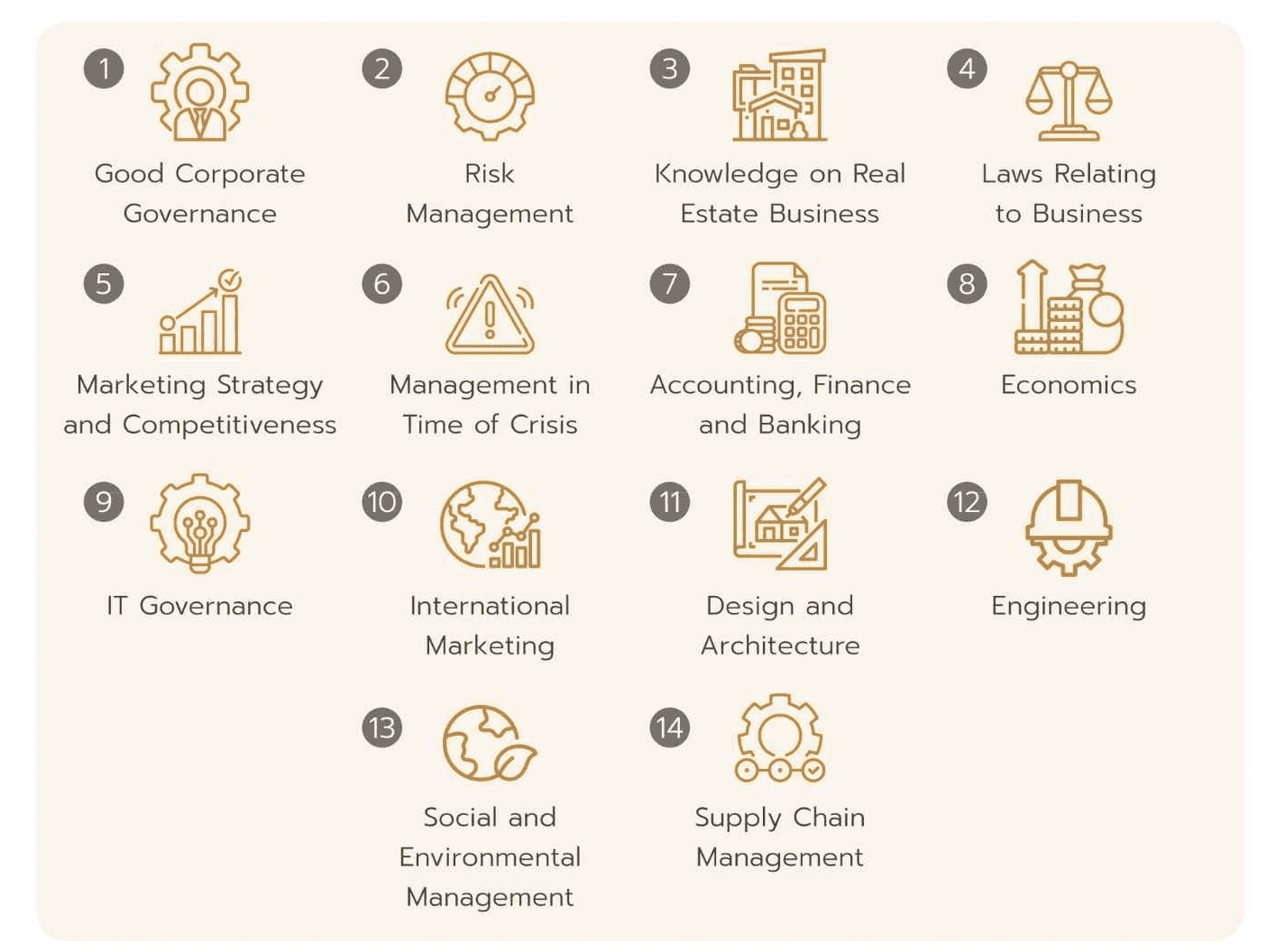
Rules on self-assessment regarding necessary skills for performing duties of the Board of Directors are as follows:
Level of Expertise (%) | Level |
More than 86 | Level 4 : Excellent |
76 - 85 | Level 3 : Very Good |
66 - 75 | Level 2 : Good |
50 - 65 | Level 1 : Fair |
Less than 50 | Level 0 : To be improved |
The Company Secretary has distributed the Board Diversity Self-Assessment Form to all members of the Board of Directors for annual self-evaluation. After each director completes their self-assessment, they return the form to the Company Secretary for compilation of the Board Diversity Self-Assessment scores. The Nomination and Remuneration Committee has reviewed and determined that the Board's structure possesses diverse knowledge and capabilities, fostering a balance of perspectives, work quality, and decision-making efficiency, which benefits the Company's business operations. According to the Board Diversity Self-Assessment results, in 2025, more than half of the directors demonstrated expertise (Level 4) in all 14 skills and knowledge areas, as follows:
The Board Diversity Self-Assessment | |||||
Expertise level goals (%) | 2021 | 2022 | 2023 | 2024 | 2025 |
Level 4 | level 3 : Very Good | level 3 : Very Good | level 3 : Very Good | Level 4 : Excellent | Level 4 : Excellent |
More than 86% | 80.83% | 81.25% | 82.86% | 88.39% | 86% |
The results of the Board Diversity Assessment for the year 2025
showed the number of directors who are rated for each level of proficiency
separately based on the skills required to perform their duties
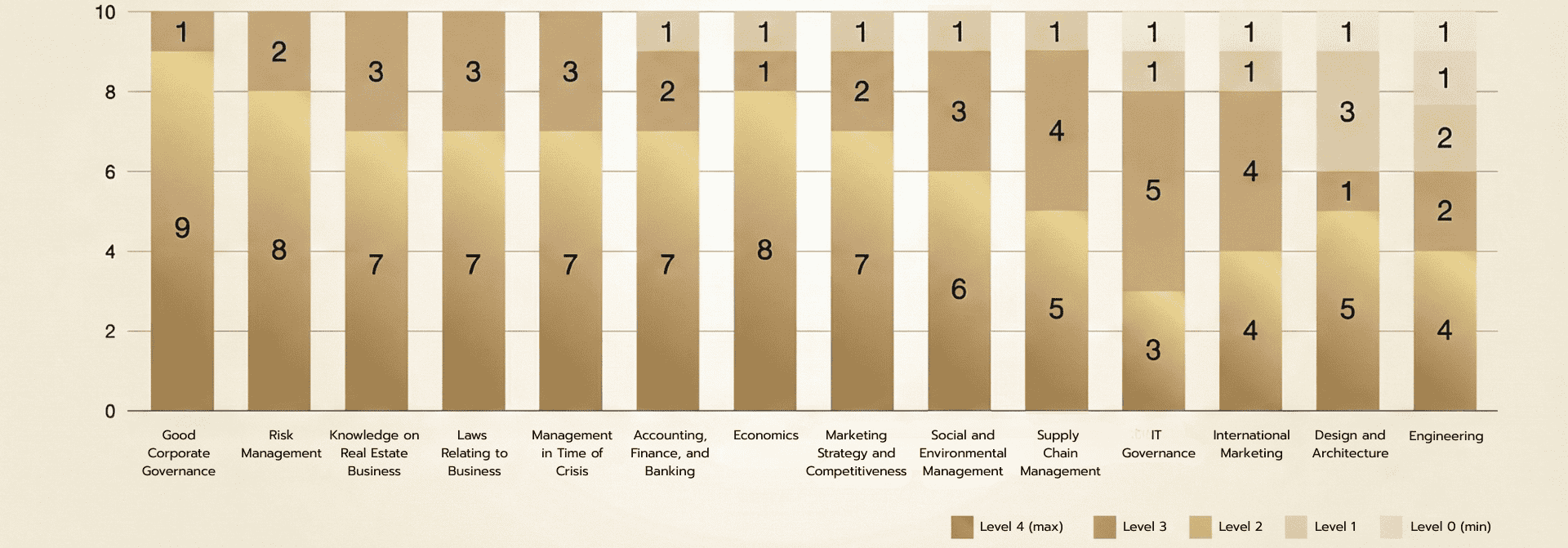
Evaluation of Board Performance in the Past Year
Performance Assessment of the Committee
The Board of Directors conducts an annual performance evaluation at least once a year. The evaluation forms are designed to align with the Company’s Good Corporate Governance Principles, as well as the scope of duties and responsibilities of the Board. This evaluation process encompasses the board evaluation, individual director evaluation, and the performance of subcommittees.
The Company focuses on utilizing the evaluation results to review the Board’s performance and address any issues or obstacles encountered during the past year. These insights are used to enhance the efficiency of the Board’s governance and functional processes, as well as to establish guidelines for potential development and strengthen the effectiveness of the Company’s corporate governance. Furthermore, these evaluation results serve as a key reference for the Company’s Corporate Governance Rating (CG Rating) assessment. In 2025, the appraisal was done in 2 characteristics, they are, 1) the assessment of the whole Committee; 2) the assessment made on an individual basis (self- assessment). The assessment forms were divided into 10 categories consisting as follows:
Performance Assessment | The Whole Board of Directors | Individual Member of the Board of Directors (Self- Assessment) |
Board of Directors | / | / |
Sub-Committees | ||
| / | / |
| / | / |
| / | / |
| / | / |
Assessment Process for the Whole Committee and Each Individual Member
In every year, the Secretary of the Nomination and Compensation Committee shall deliver the performance evaluation forms of the Board of Directors and the Sub-committees to all directors for the annual performance assessment in relevant parts. After each director has completed the evaluation, the performance evaluation forms shall be returned to the Secretary of the Nomination and Compensation Committee to compile the evaluation scores of each director, summarize the analysis of the performance evaluation results of various committees for the year, and report to the Nomination and Compensation Committee for acknowledgment. In this regard, the Chairman of the Nomination and Compensation Committee presented the evaluation results to the Board of Directors' meeting on February 24, 2026, which can be illustrated as follows:
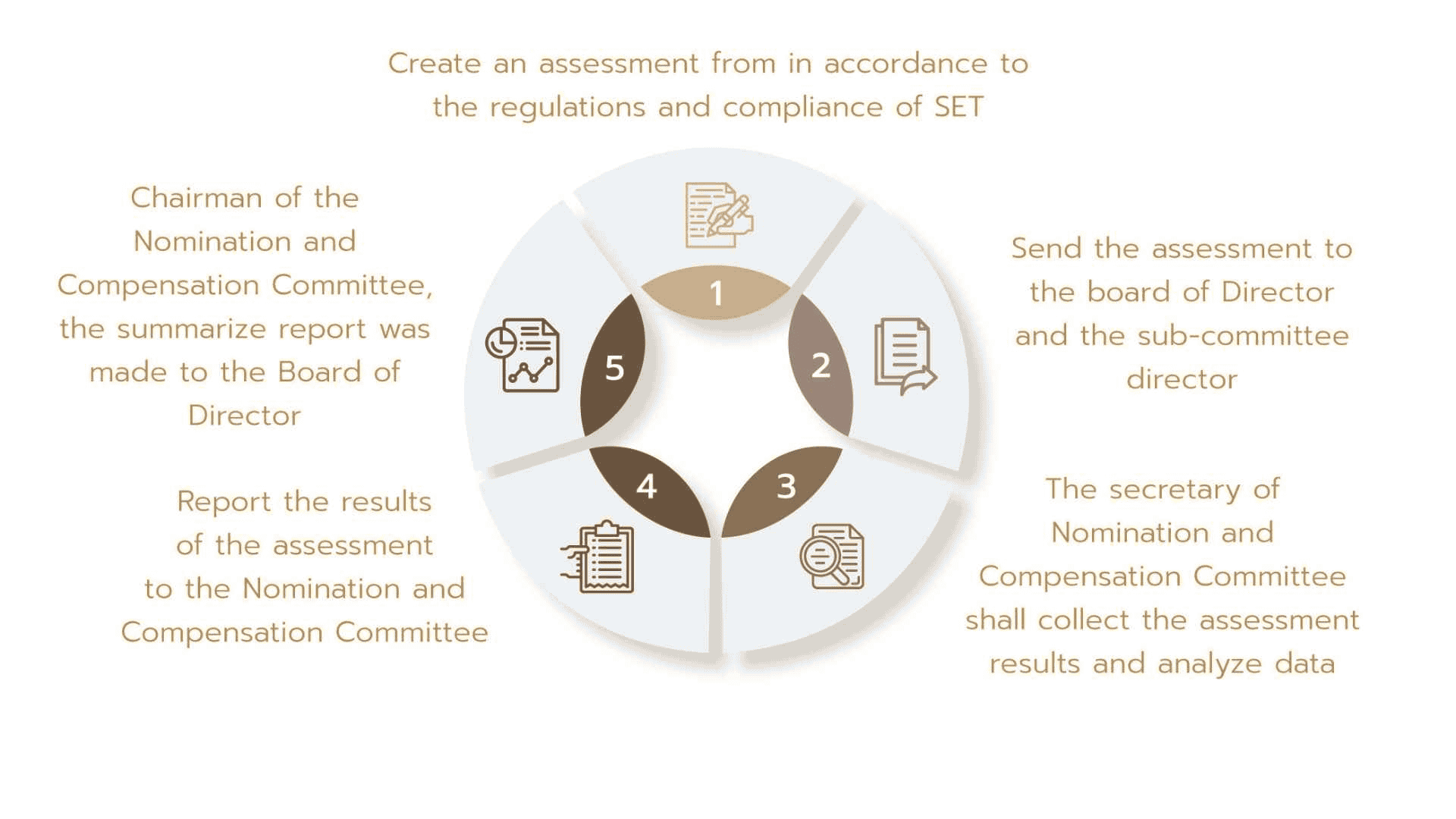
The assessment results in percentage are as follows:
Level of Assessment (%) | Level |
More than 86 | Excellent |
76 - 85 | Very Good |
66 - 75 | Good |
50 - 65 | Fair |
Less than 50 | To be improved |
1. Performance Evaluation Form of the whole Board of Directors and individual members of the Board of Directors (self-assessment), the results can be summarized as follows:
Performance Assessment of the Board of Director | ||
Amount of Items | The Whole Board of Directors | Individual Member of the Board of Directors (Self-Assessment) |
6 items | 10 items | |
Detail | 1. Structure and Qualification of the Board of Directors. 2. Roles, Duties, and Responsibilities of the Board of Directors. 3. Board of Directors’ Meetings. 4. Performance of the Board of Directors. 5. Relations with management department. 6. Self Development of the Board of Directors and Executive. | 1. The Board of directors’ meeting attendance consistently. 2. Studying documents and information before the meeting. 3. During the meeting provides appropriate opinions that are beneficial to the meeting. 4. Absenting from the meeting and abstain from voting in the transaction in which they have interests. 5. Raising important issues affecting the Company's business operations and present them to the Meeting. 6. Performing the duties of the directors according to the laws, rules, and charter effectively. 7. Devoting time and dedicating to performing duties for the Company. 8. Not interfere with the Management's operations. 9. Controlling and monitoring operations of the Management appropriately 10. Developing and learning to enhance skills in performing duties all the last year. |
Board of Directors' Performance Evaluation | |||||||
The Whole Sub-Committee | Individual Member of the Sub-Committee (Self- Assessment) | ||||||
Target | Year | Target | Year | ||||
2023 | 2024 | 2025 | 2023 | 2024 | 2025 | ||
Excellent More than 86% | Excellent 97% | Excellent 97% | Excellent 96% | Excellent More than 86% | Excellent 93% | Excellent 93% | Excellent 93% |
2. Performance Evaluation Form of the whole Board of Directors and individual member of the sub-committee (self-assessment), the results can be summarized as follows:
Performance Assessment of Sub-Committee | ||
Amount of Items | The Whole Sub-Committee | Individual Member of the Sub-Committee (Self- Assessment) |
3 items | 10 items | |
Detail | 1. Structure and Qualification of the Audit Committee. 2. Performing duties at Sub-committees’ Meetings efficiently. 3. Roles, duties and responsibilities of subcommittees by focusing and taking sufficient time to consider and review. | 1. The Sub-Committees’ meeting attendance consistently. 2. Studying documents and information before the meeting. 3. During the meeting, the Directors provides appropriate opinions that are beneficial to the meeting. 4. Absent from the meeting and abstain from voting in the transaction in which they have interests. 5. Raising detected important issues and presenting them to the Meeting. 6. Directors have performed the duties of the directors according to the laws, rules, and charter effectively. 7. Devoting time and dedicating to performing duties for the Company. 8. Supporting and providing opinions that are useful to the Management's operations. 9. Controlling and monitoring operations of the Management appropriately. 10. eveloping and learning to enhance skills in performing duties all the last year. |
Name of Sub-Committee | Sub-Committee Performance Evaluation | |||||||
The Whole Sub-Committee | Individual Director Evaluation Results | |||||||
Target | Year | Target | Year | |||||
2023 | 2024 | 2025 | 2023 | 2024 | 2025 | |||
The Audit Committee | Excellent More than 86% | Excellent 99% | Excellent 99% | Excellent 94% | Excellent More than 86% | Excellent 92% | Excellent 93% | Excellent 95% |
The Nomination and Compensation Committee | Excellent 100% | Excellent 100% | Excellent 98% | Excellent 100% | Excellent 100% | Excellent 100% | ||
The Corporate Governance and Sustainability Development Committee | Excellent 100% | Excellent 99% | Excellent 98% | Excellent 100% | Excellent 100% | Excellent 100% | ||
The Risk Management Committee | Excellent 95% | Excellent 95% | Excellent 92% | Excellent 91% | Excellent 91% | Excellent 91% | ||
Performance Assessment of the Chief Executive Officer (Senior Executive)
Performance Evaluation Criteria
There are the criteria for evaluating performance of the Chief Executive Officer which administrate under the mission, vision, strategy of the Company, business goals and annual business plans. In addition, economic, social, environmental, and good governance performances shall be applied as a part of the performance indicators of the Chairman of the Executive Committee to reflect the organization's awareness of sustainability integration as a part of sustainable business operations. There are two areas of indicator defined as follows:
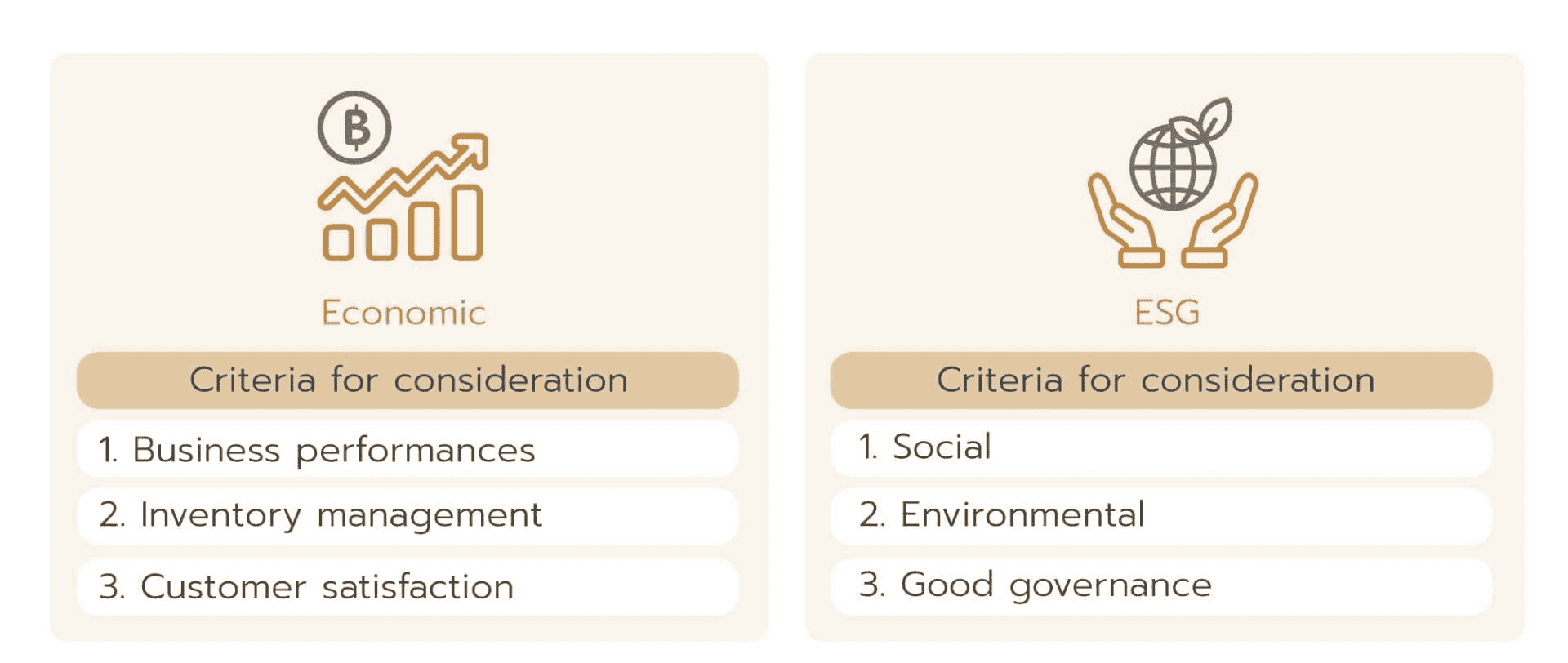
Level of Assessment (%) | Level |
More than 86 | Excellent |
76 - 85 | Very Good |
66 - 75 | Good |
50 - 65 | Fair |
Less than 50 | To be improved |
Performance Evaluation Process
The Company specified a remuneration policy of the Chief Executive Officer, which the Board of Directors are assigned to consider the results of the Company’s operation based on indicator (KPI: Key performance Indicator) approved by the meeting of Board of Directors, thereafter the Nomination and Compensation Committee will consider the results of performance and consider both the short and long-term remuneration of the Chief Executive Officer to comply with the result of performance based on indicators.
Results of Performance Evaluation of the President (Senior Executive)
In 2025, the performance evaluation results of Dr.Prateep Tangmatitham, Chairman of the Executive Committee, were 81.90%, which was a very good level, all aspects of assessment represented the satisfaction of overall performances. The summary of results and obstacles was reported, including the review of the evaluation criteria indicators, which covered the economy, society and/or environment, to the Board of Directors' Meeting No. 2/2026 on February 24, 2026, in order to enhance operational efficiency and reflect the organization's awareness of sustainability integration as a part of sustainable business operations.
Evaluation Results
| Evaluated Body | Group — Carried Out? | Group — Grade / Average Score | Group — Grade / Full Score | Individual (Self-Assessment) — Carried Out? | Individual (Self-Assessment) — Grade / Average Score | Individual (Self-Assessment) — Grade / Full Score | Cross (Assessing Other Directors) — Carried Out? |
|---|---|---|---|---|---|---|---|
| Board Of Director | Y | 95.96 | 100 | Y | 92.80 | 100 | N |
| Audit Committee | Y | 93.65 | 100 | Y | 94.67 | 100 | N |
| Other Subcommittee | Y | 97.85 | 100 | Y | 100 | 100 | N |
| Other Subcommittee | Y | 97.78 | 100 | Y | 99.50 | 100 | N |
| Other Subcommittee | Y | 92.39 | 100 | Y | 90.63 | 100 | N |
Subcommittees
Subcommittees
| Results of the Subcommittee's Duty Performance | Meetings — Introduction | ||||||
|---|---|---|---|---|---|---|---|
Nomination of Persons to be Appointed as Directors The nomination methods for the Board of Directors are established with criteria and transparency, adhering to good practice guidelines under the good corporate governance principles, in order to build confidence for shareholders and all stakeholders. They are disclosed in Form 56-1 e-One Report and on the Company's website. In addition, the Nomination and Compensation Committee provides opportunities for shareholders to nominate names of persons deemed appropriate to be selected as directors. From September 10, 2024, to November 11, 2024, there was no shareholder nominating a candidate for appointment as a director, so the Nomination and Compensation Committee proposed to consider re-electing the directors who retired by rotation for the year 2025 to be a director for another term. The Shareholders' Meeting passed the resolution to approve the appointment of new directors as proposed. The newly appointed directors meet all qualifications under the Public Limited Companies Act and do not possess the prohibited characteristics as stipulated or specified in laws that are applicable to the Company. In addition, they are qualified persons, have no interests or conflicts of interest with the Company, and possess qualifications, knowledge, and capabilities in line with the Company's business strategies. This involves overseeing the succession plan and maintaining an up-to-date succession pool of executive management to ensure business continuity and alignment with the company’s corporate strategy. However, details are disclosed for transparency of the audit in this Form 56-1 e-One Report. According to the results of the assessment, it is concluded that all independent directors are independent and reviewed the Policy on Remuneration of Directors, Chief Executive Officer, and Executive Management. Determination of Compensation for Board of Directors, Subcommittees, and Executive Committee Guidelines for determining the compensation for the Board of Directors, sub-committee, Chairman of Executive Committee and executive management are considered. Methods and rules for determining fair and reasonable compensation are also established based on performances and operational achievements compared with Key Performance Indicators (KPIs), which are in line with the interests of stakeholders. They cover the performances on economic, social, environmental, and corporate governance aspects. Compensation consideration takes into account the responsibility of directors, size of business, business environment, overall economic situations, and performances reflected and linked to the operating results. In addition, the Company’s compensation rate must be compared with that of the same industry, which is at a competitive level and reasonable. The compensation rate was proposed to the 2025 Annual General Meeting of Shareholders for approval. The compensation of directors, sub-committees as well as the Chairman of the Executive Committee and senior executives, is considered appropriately based on performances and the Company's operating results. Human resource management policy and plans are considered to be in line with the Company's business strategy. Opinions are provided to the Chairman of the Executive Committee for presenting to the Board of Directors accordingly. Evaluation of Performances of the Board of Directors, Sub-committees and Independent Directors Self-Assessment of the Board of Directors and the sub-committees (the whole group) is provided individually. It is reported to the Board of Directors for acknowledgment in order to apply the evaluation results to improve operations and achieve the objectives of the Company. In addition, independent directors' independence is assessed annually. In 2025, independent directors' performances are evaluated additionally. The evaluation results concluded that all independent directors met the qualifications under the rules of the Securities and Exchange Commission of Thailand and also performed duties completely based on the assigned scope of duties, expressed opinions independently, and had no conflict of interest or significant interests with the Company. Improvement and Development of Roles and Duties of the Nomination and Compensation Committee The charter of the Nomination and Compensation Committee is considered and reviewed annually. Any matters are screened based on roles and duties to improve the performance of duties for the highest benefits of shareholders, which are proposed to the Board of Directors for approval. In addition, the qualifications of the Chairman of the Executive Committee in the policy on the succession plan are also reviewed. Composition and Diversity of the Board of Directors The level of expertise of the entire Board of Directors structure is considered and determined according to the average board skill matrix of not less than 80% board diversity, and the key performance indicators (KPIs) and review the necessary qualifications and skills for the nomination of directors are considered and reviewed in order to review the structure, composition, and expertise of the Board of Directors and sub-committees of the Company in accordance with the Company's business strategy. This served as supporting information for the consideration of the nomination of directors retiring by rotation and the selection of directors. The Nomination and Compensation Committee was of the opinion that the current composition of the Board of Directors and sub-committees is appropriate for the Company’s business. The Nomination and Compensation Committee pays attention to the meeting attendance and proposes useful opinions and information to develop nominations and determine the compensation for all related persons fairly and appropriately. The Nomination and Compensation Committee performs operations in accordance with the good corporate governance guidelines of the Stock Exchange of Thailand, which are consistent with the Corporate Governance Code and ASEAN CG Scorecard (ACGS). All opinions and suggestions of the Nomination and Compensation Committee can be used as a tool for the Board of Directors to consider with confidence and reliability. Director Development Plan All directors are encouraged to attend trainings or participate in activities to continuously develop knowledge by using the Company's resources. In addition, each director has to conduct the self-assessment on the board skill matrix. The skills applied for evaluation are comprehensive and consistent with the Company's business strategies. Virach Aphimeteetamrong (Assoc. Prof. Dr. Virach Aphimeteetamrong) Chairman of the Nomination and Compensation Committee The performances of the Nomination and Compensation Committee over two meetings can be summarized as follows:
| Report of the Nomination and Compensation Committee The Nomination and Compensation Committee consists of at least 3 directors and more than half of them must be independent directors. The Nomination and Compensation Committee performs duties as assigned with duty of care, prudence, transparency, integrity, and reasonableness, including reviews operations in accordance with the current situation and the Company's operating strategies by mainly taking into account the highest interests of shareholders and all stakeholders. In addition, the Committee must study additional information of related matters comprehensively and encourage each director to express opinions independently and constructively based on their duties and responsibilities set out in the charter of the Nomination and Compensation Committee. In 2025, there were 2 Nomination and Compensation Committee’s meetings, and the results of the meetings were reported together with opinions and suggestions to the Board of Directors for acknowledgement continuously. The key operations in 2025 can be summarized as follows: | ||||||
The Corporate Governance and Sustainable Development Committee focuses on and is committed to enhancing the effectiveness of its good corporate governance practices. Furthermore, the Committee provides strategic oversight of the Company’s sustainability matters by regularly monitoring ESG performance, sustainability risks, and progress toward Environmental, Social, and Governance (ESG) targets. It reports these outcomes to the Board of Directors to ensure that business operations align with corporate strategy and international sustainability disclosure standards. Its operations are managed with transparency, fairness, and accountability. The Committee also monitors the implementation of the good corporate governance plan, adhering to the Code of Conduct for sustainable growth. The Committee’s responsibilities also extend to anti-corruption efforts, ensuring fairness, and upholding responsibility towards all stakeholders, including employees, customers, trade partners, communities, contractors, shareholders, society, the environment, and government agencies. Furthermore, the Committee emphasizes sustainability management encompassing economic, environment, social, and governance aspects. The key highlights are as follows: 1. Rights of Shareholders and Equitable Treatment of Shareholders
2. Consideration of Stakeholder Roles and Sustainable Business Development
3. Information Disclosure and Transparency
4. Responsibilities of the Committee
5. Corporate Governance Awards The Company was ranked in the category of “Excellence” for the 13th consecutive year based on the survey results of the Good Corporate Governance of Listed Companies in 2025 organized by the Thai Institute of Directors Association collaborating with the Stock Exchange of Thailand and the Office of the Securities and Exchange Commission, Thailand. Additionally, the Company was recognized as an "ASEAN Asset Class PLC" from the ASEAN Corporate Governance Scorecard (ACGS) assessment for 2024. The Corporate Governance and Sustainability Development Committee is still committed to developing transparent operations on corporate governance to be a good model, as the Corporate Governance and Sustainability Development Committee absolutely believes that the management based on the rule of law, integrity, transparency, traceability, and continuous improvement of good corporate governance, including the emphasis on the highest responsibility with the stakeholders, will cause the organization to grow sustainably and build confidence to shareholders and all stakeholders. Somjai Phagaphasvivat (Assoc. Prof. Dr. Somjai Phagaphasvivat) Chairman of the Corporate Governance and Sustainable Development Committee The performances of the Corporate Governance and Sustainability Development Committee which convened one meeting can be summarized as follows:
| Report of the Corporate Governance and Sustainable Development Committee The Corporate Governance and Sustainable Development Committee comprises 4 members. Its Chairman is an independent director. In 2025, the Committee held 1 meeting. The Committee is responsible for overseeing the Company’s business operations to ensure they are in accordance with the principles of good corporate governance, aligned with the principles of good corporate governance of the Stock Exchange of Thailand and the international principles of the Organization for Economic Cooperation and Development (OECD). | ||||||
In 2025, two Risk Management Committee's meetings were held to determine, review, and update the Risk Management Policy, Charter of the Risk Management Committee, Corporate Risk Management Framework, and Corporate Risk Management Process to the rapidly changing situations and the business operations, and also to provide recommendations on risk management guidelines that are consistent with the strategic direction of the business plan. This is to allow the risk owner to manage significant risks to risk appetite and to ensure that the Company has adequate and effective risk management in accordance with the Enterprise Risk Management Framework (COSO ERM 2017), as well as to continuously support the development of risk management at all levels to create the organizational culture of risk management. In addition, there is follow-up, evaluation, review, and approval for the risk management plan, which covers various types of major risks, including Strategy Risk, Operation Risk, Financial Risk, Compliance Risk, Corruption Risk, Market Risk, Cybersecurity Risk, Emerging Risk, and Risks on the Company's sustainability issues covering Environmental, Social, and Corporate Governance Risk (ESG Risk), including Climate Risk and reporting the results of the risk management to the Board of Directors. According to the performance of duties of the Risk Management Committee in the previous year, the Risk Management Committee had taken steps to ensure that risk management was adequate and appropriate, which had been implemented continuously until the risk was at an acceptable level for the Company. The implementation was as follows:
The Risk Management Committee has the following key action plans in 2025:
According to the implementation of risk management, the Company is confident that it will be able to achieve its business goals in order to maximize the benefits of shareholders and all groups of stakeholders.
Atip Bijanonda (Mr. Atip Bijanonda) Chairman of the Risk Management Committee The performances of the Corporate Governance and Sustainability Development Committee which convened one meeting can be summarized as follows:
| Report of the Risk Management Committee The Risk Management Committee performs duties as assigned by the Board of Directors. Its scope of duties and responsibilities is specified in the Charter of the Risk Management Committee. | ||||||
In 2025, the Independent Committee held an internal meeting as appropriate, once on August 13, 2025, to discuss various issues related to the management of the company's business or other matters of interest that benefit the company. They considered the best interests of all shareholders and stakeholders, especially minority shareholders, and oversaw the risk management system, internal controls, and timely and complete information disclosure to build investor and capital market confidence. The issues discussed in the meeting were reported to the company's board meeting No. 9/2025 on September 9, 2025, by Assoc. Prof. Dr. Virach Aphimeteetamrong is the chairman of the Independent Committee. The meeting results are reported to the company's board of directors for their information. | Report of the independent committee The Independent Committee consists of 4 members. |





Meeting Attendance & Remuneration
Meeting Attendance — Introduction
The Company holds Board of Directors’ meetings at least once a month, with the annual meeting schedule determined in advance, and requires directors to attend all meetings. Meeting notices, agendas, and supporting documents are distributed to directors at least seven days prior to each meeting to allow sufficient time for review. Regular attendance at Board meetings is in accordance with the Corporate Governance Code and reflects the strength of the Company’s governance practices under the ESG framework, and is used as one of the criteria for evaluating the performance of the Board.
Meeting Attendance — Sub-section Introduction
Efficiency Evaluation of the Board Meetings
The Company has organized efficiency evaluation of every Board meeting on a yearly basis. In 2025, there were 12 Board meetings. The criteria used for efficiency evaluation of the Board meetings consist of the following 10 items:
Notifying the meeting at least 7 days before the date of the meeting.
Receiving documents in full along with letter of invitation.
Beginning on time with time control.
Appropriateness and clear details of each agenda.
Participation of Directors.
The management provides sufficient information to the Board of Directors to make decisions.
Taking into consideration the benefits of stakeholders.
Summary of clear resolutions of the meeting.
Control and management of conflicts by the Chairman in the meeting.
Attendees rate.
Efficiency Evaluation Criteria of the Board Meetings
Level of Assessment (%) | Level |
90 - 100 | Excellent |
80 - 89 | Very Good |
70 - 79 | Good |
60 - 69 | Fair |
Less than 50 | To be improved |
From the full score of 100%, the average efficiency evaluation of the Board meeting in 2025 was 98.31%, an excellent outcome.
Justification for Directors' Non-Attendance
Over the past year, some directors were unable to attend certain meetings due to health issues. The Company places primary importance on the appropriateness and well-being of its directors.
As for another director, they had an important pre-scheduled commitment overseas and informed the Company in advance. Nevertheless, the director was informed of the meeting agenda beforehand and provided comments and/or recommendations to the management or the Chairman for consideration at the meeting.
Types of Remuneration of the Board of Directors
Compensation for Directors and Executives
The Company specified the policy on rules of presentation and consideration for compensation of directors to create the incentives of assigned performance to achieve goals effectively. The Nomination and Compensation Committee is assigned to carefully consider the Compensation rates of the committee, scrutinize the suitability of various reasons thoroughly, compare and refer by the same business including consideration from the expanding business, where shall be presented to the Board of Directors and the meeting of shareholders.
The directors receive monthly remuneration and pension. Such remuneration is set to be the level comparable to the same industry group.
Directors who are assigned to perform additional duties and responsibilities (such as being a member of the sub-committee) will receive additional remuneration which relates to the level of assigned responsibility, except the executive directors.
The Company shall not pay any money or other property to directors unless the remuneration is paid as the rights and benefits habitually as being the Company’s director.
The remuneration of directors shall be paid in accordance with the resolutions of the shareholders' meeting which comprise a vote not less than two in thirds of the total votes of shareholders who join the meeting.
Remuneration Policy for Directors
The Company has the criteria for providing remuneration to the Board of Directors and Sub-Committees clearly and transparent, which shall be considered the same industrial sector and business expansion. It’s believed that such remuneration could attract, retain and motivate the directors to perform their roles and carry out their responsibilities to accomplish the Company’s goals efficiently.
In 2025, The Annual General Meeting on April 22, 2025, resolved that approve the Remuneration for Board of Directors, as detail below
Remuneration for the Board of Directors | ||
1. Remuneration/month | Chairman, Director 45,000 Baht/person/month | |
2. Special Remuneration/year | Chairman, Director 800,000 Baht/person/year | |
3. Other benefits (not including general welfare to employees) | 1. Directors and Officers Liability Insurance (D&O Insurance) 2. The right to attend training courses and seminars organized by the Thai Institute of Directors Association (IOD) and other relevant institutions 3. Privileges for purchasing products and services of the Group's companies | |
Remuneration for the Audit Committee | ||
1. Chairman | 35,000 Baht/person/month | |
2. Director | 30,000 Baht/person/month | |
Remuneration of –Sub-Committee: Meeting allowance will be paid only once at the meeting (Sub-Committees comprise of (1) The Nomination and Compensation Committee (2) The Corporate Governance and Sustainability Development Committee (3) The Risk Management Committee and the other sub-Committee appointed by the Committee. (not including Executive Director) | ||
1. Chairman | 35,000 Baht/person/meeting | |
2. Director | 30,000 Baht/person/meeting | |
Remuneration of the Board of Directors
Remuneration or Benefits Payable to the Board
| Metric | Amount (Baht) |
|---|---|
| Remunerations or benefits pending payment to the board of directors over the past year (baht) | 0 |
Supervision of Subsidiaries & Associated Companies
Does the Company Have Subsidiaries or Associated Companies?
Yes
Is There a Mechanism for Overseeing Subsidiaries and Associated Companies?
Yes
Mechanism for Overseeing Management of Subsidiaries
Supervision of the Subsidiaries’ Operations
The Company has established a policy for overseeing the operations of its subsidiaries. This includes selecting directors with the appropriate knowledge, capabilities, qualifications, and experience relevant to the nature of the subsidiary's business to serve as directors with controlling authority in the subsidiary. These selections have been approved by the Company's Board of Directors. In cases where a subsidiary has significant matters, such as approval of capital increases or decreases, dissolution of the subsidiary, and joint ventures, approval from the Company's Board of Directors is required in all instances. The Board of Directors has resolved to appoint directors with the following scope of authority, duties, and responsibilities:
Financial reporting
The Board of Directors oversees the Company and its subsidiaries to ensure transparency. Therefore, it requires the use of the same external auditor as the Company. This enables the auditor to examine various transactions and obtain sufficient appropriate evidence to express an opinion on the consolidated financial statements.
Resources
The Board of Directors allocates and manages the resources of the Company and its subsidiaries efficiently and effectively. These include the SAP (PRD) system and the 1720 complaint channel, aimed at supporting operations to ensure convenience, speed, and enhanced work efficiency.
Legal compliance
A dedicated department oversees the operations of the Company and its subsidiaries to ensure adherence to relevant regulations and rules. This department is responsible for safeguarding the interests of shareholders, contributing to the sustainable value creation of the business.
Internal control system
The Board of Directors ensures that an appropriate and effective internal control system is in place. The Audit Committee approves the internal audit plan, which includes reviewing operational and internal control systems, and reports directly to the Audit Committee and the Board of Directors.
Regarding adherence to the Code of Conduct
The Board of Directors oversees that directors, executives, and employees of the Company and its subsidiaries comply with the Code of Conduct and various policies in accordance with good corporate governance principles. It also monitors compliance with corporate governance policies and practices.
Oversight Mechanisms
| Mechanism |
|---|
| Transactions between the Company and related persons |
| Internal control system of the subsidiary operating the core business is appropriate and sufficient in the subsidiary operating the core business |
| Sending representatives to act as directors, executives or controlling persons in proportion to shareholdings |
| Disclosure of financial information and operating results |
Board Duty Performance — Overview
Board Duty Performance — Overall Description
The Board of Directors is responsible for defining the corporate vision, policies, and business strategies while overseeing material sustainability issues. These include climate change, ESG risk management, supply chain governance, and stakeholder impacts, all aimed at driving long-term value creation for shareholders and all stakeholder groups.
In addition, the Board monitors and evaluates the performance of the management to ensure that operations are conducted in accordance with the approved plans and strategic direction, while providing policy guidance and recommendations that contribute to the Company’s long-term development.
Audit Committee Duty Performance
Audit Committee Duty Performance — Introduction
The Board of Directors approved the establishment of the Audit Committee on November 18, 1999, by appointing the Company’s directors who possess qualifications according to the Securities and Stock Exchange Act and as set out by the Stock Exchange of Thailand. The Board of Directors' Meeting of Supalai Public Company Limited (the “Company”), No. 11/2025, held on November 11, 2025, approved the increase in the number of Audit Committee members by 1 person, from 3 to 4, by appointing Assoc. Prof. Dr. Virach Aphimeteetamrong, an Independent Director of the Company, as an additional Audit Committee member. Owing to his independence, knowledge, expertise in accounting and finance, and experience in reviewing the reliability of financial statements, this appointment is to ensure that its composition is appropriate for the scale and business complexity of the Company. Moreover, it reinforces robust corporate governance practices in accordance with the good corporate governance criteria for listed companies (CGR) and international standards (ASEAN Corporate Governance Scorecard), which require that at least one member of the Audit Committee should have recent and relevant accounting expertise or financial experience.
Results of the Audit Committee's Duty Performance in the Past Year
In 2025, there were twelve Audit Committee meetings, which were reported to the Board of Directors. The meetings were held with executives in charge of accounting and finance. Additionally, there were meetings with external auditors every quarter. The auditors of the Company and its subsidiaries are EY Office Limited. Certified public accountants have no relationship or interest with the Company, subsidiaries, executives, major shareholders, or persons related to such persons in any way. Therefore, they are independent to audit and express opinions on the Company's financial statements.
In the previous fiscal year, the Company and its subsidiaries did have any non-audit fees from the audit office where the auditors were affiliated with persons or businesses relating to the auditors. The audit office, which the auditors were affiliated with (for details, please see Section: 7.6.3 Auditing Fee), and the Company were able to comply with the requirements of external agencies and relevant laws.
Furthermore, the Audit Committee held a meeting with the external auditors without the presence of Management. This was to ensure an independent exchange of information regarding audit issues, risk assessments, and internal control systems.
Performance of Duties of the Audit Committee
In 2025, the Company held twelve Board of Directors’ Meetings, covering four core roles in alignment with international standards: 1) Financial Reporting Oversight 2) Internal Control System Oversight 3) Internal Audit Function Oversight 4) External Auditor Oversight. The summaries are as follows:
Quarter | Description |
|
|
|
|
|
|
|
|




Executive Committee Duty Performance
Results of the Executive Committee's Duty Performance in the Past Year
The Executive Committee requires the Management Committee to regularly report progress and performance to the meeting, as well as to review and filter significant investment projects, including the annual budget, before presenting them to the Board of Directors. Additionally, it reviews the organizational structure and human resource management, the appointment and development of senior executives, and oversees the establishment of an appropriate and sufficient risk management system, internal control system, and operational authority manual, including approving investment items within the delegated authority.